For years, major polluter BP has sponsored the ‘Science Museum Group’ – a deal which has:
- helped BP to misleadingly promote itself as a green and responsible company;
- allowed BP to influence the content of the museum’s former Energy Gallery; and,
- supported BP’s efforts to bolster its ties to Russia at a time when it held a major stake in national oil company Rosneft, by inviting it to sponsor a high-profile exhibition on the ‘Cosmonauts’.
Crucially, sponsoring the Science Museum has allowed BP to recruit the institution and its Director to act as one of its most vocal defenders in the national media – something we now know was part of a carefully calculated strategy to boost the company’s so-called “social licence” to operate.
Today, we’re revealing damning new details behind BP’s current sponsorship of the museum’s ‘Science Museum Group Academy’ for training educators across the country. While the museum continues to claim that it ‘retains editorial control of the content within our exhibitions and galleries’ – that BP and other sponsors have had no say over its curatorial or programming decisions – we’ve discovered how the multi-year research project that led to the creation of the museum’s Science Museum Group Academy was funded – and chaired – by BP, with the company able to directly veto decisions over the project’s direction.
These FOI disclosures make clear that BP played a central role in the ‘Enterprising Science Project’, the foundational research that underpins the ‘Science Museum Group Academy’ teacher and educator training programme at the Science Museum, which BP sponsors today, and which forms a central part of BP’s education and social licence strategy.
Previously unpublished FOI disclosures reveal:
- BP’s direct influence over ‘Enterprising Science’, the foundational research project which formed the basis of the Science Museum’s ongoing ‘Science Museum Group Academy’ for training teachers and educators – which BP now sponsors as well;
- How the formal agreement specified the significant say and control that BP would hold over the project, that major decisions would not be “validly passed…unless the representative of BP votes in its favour” and that BP would “set out the distinctive characteristics of [the Enterprising Science Project] which Science Museum and KCL may not duplicate”;
- the extensive reach of the BP-sponsored Science Museum Group Academy to educators and pupils and new insight into the tangible benefits sold to BP as the sponsor of the Science Museum Group Academy;
- how even though BP likely breaches the museum’s sustainability criteria for corporate sponsors after the company scrapped its climate goals, the museum continues to actively endorse and support its sponsor, with museum staff saying to BP they “would love the opportunity to meet in person and gain a deeper understanding of your organisation’s goals and objectives, particularly around The SMG Academy.”
These documents add to existing insights into BP’s strategic use of STEM education programmes and sponsorships in order to extend the company’s influence:
- In a formal submission to a UK parliamentary committee in 2017, BP openly states that one of its ‘desired outcomes’ of the project – alongside BP’s other STEM initiatives – is to provide pupils with ‘industrial and BP context for their learning’.
- Internal documents from 2016, recently reported on by climate investigations outlet DeSmog, showed how BP America’s Communications & External Affairs team was told to mitigate the potentially harmful impact of “detrimental policy and political developments” by “leveraging our distinctive position as a champion of STEM education”.
- In 2023, BP appears to have abandoned its ‘BP Educational Service’ brand identity – which previously hosted its Ultimate STEM Challenge for schools in collaboration with the Science Museum – and rebranded its resources and activity in STEM as ‘energisingfutures.co.uk’. Now, BP’s own involvement is all but concealed with BP only named discreetly on the FAQs page.
- On the FAQs webpage for ‘Energising Futures’ BP makes the motivations for its involvement in STEM explicit, saying:
“Why does bp invest in education?
bp want[s] to support the STEM skills development needed to create a diverse, high-quality talent pipeline for the future.”
1. The Science Museum Group Academy
The Science Museum Group Academy is a central part of the Science Museum Group’s offer to schools and educators across the UK – although the scale and extent of BP’s involvement remains largely hidden from view. On the Science Museum Group Academy webpage, BP is merely referred to as ‘the founding partner’.
When it was first launched, the programme was called the ‘Academy of Science Engagement’ and was described on BP’s website in the following way:
‘[The Academy] will be the UK’s first dedicated centre of excellence for practitioners in the informal STEM sector. Rooted in 25 years of experience delivering informal science training across the world, the Academy will provide research-led science engagement training, support and resources for thousands of teachers, museum and STEM professionals, improving the quality and provision of informal science learning experiences in the UK and beyond.’
The page included the following comment from Susan Raikes, the Director of Learning for the Science Museum Group at the time. While BP’s sponsorship of the museum likely represented on a very small proportion of its budget, she promotes the narrative that the museum was reliant upon the company in order for the work to take place:
‘Helping more people find meaning and relevance in science is at the heart of the Science Museum Group’s mission to inspire futures. The Academy’s vital work – which is only possible thanks to BP’s support – is a critical part of this mission. Each STEM practitioner supported by the Academy will gain the tools to create incredible science engagement opportunities for a much wider audience, helping to address the challenges of low engagement with science across the UK.’
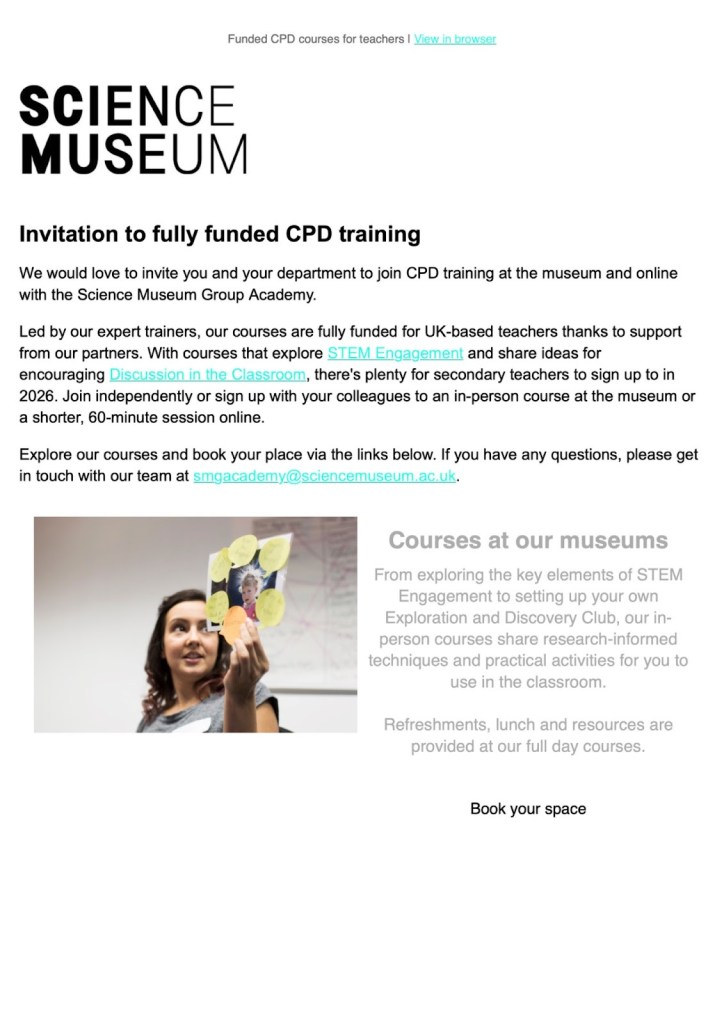
A December 2025 newsletter from the museum’s education team (see below) promotes various courses for educators and teachers that are ‘fully-funded…thanks to support from our partners’. No mention is made of the fact that BP, a major fossil fuel producing company, is one of those funders.
Since its launch, regular update reports on the Science Museum Group Academy are provided to BP as the funder, covering the number of sessions delivered, reach and wider communications. These data are then promoted by BP as part of their ongoing “social licence” work, such as being displayed prominently on BP’s community webpages. These reports also set out the various tangible benefits that are provided to BP in return for its sponsorship of the programme.
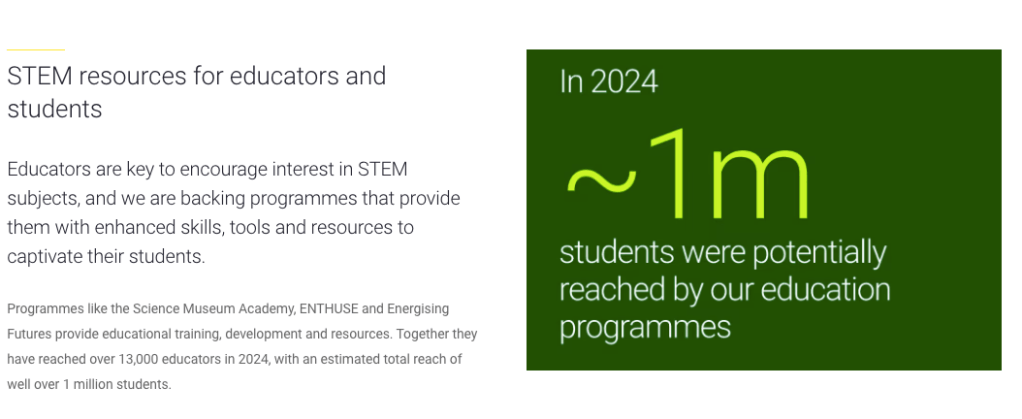
Far from being some hands-off funder of the museum’s education work, FOI disclosures make clear that The Science Museum Group Academy provides BP with a strategic opportunity for advancing its business and bolstering its reputation. On 12th March 2025 – just a few weeks after BP had abandoned its climate goals in order to ramp up its investments in new fossil fuel production – a member of staff at the Science Museum wrote to BP:
“I would love the opportunity to meet in person and gain a deeper understanding of your organisation’s goals and objectives, particularly around The SMG Academy and the incredible opportunities it provides for STEM learning thanks to your continued support.”
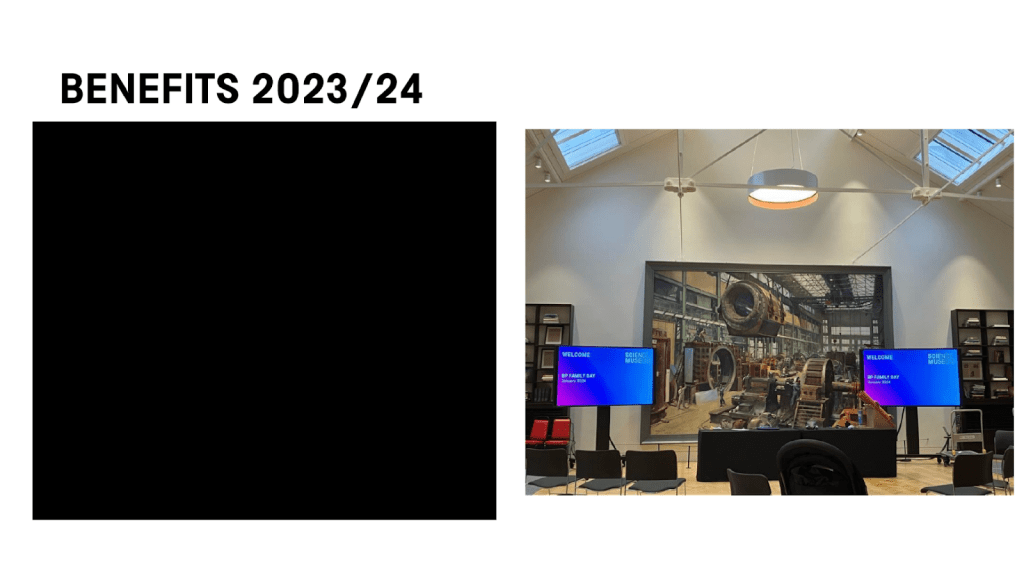
The exact number and format of tangible sponsor benefits that are provided to BP are largely redacted in the museum’s update reports. However, an image within one report clearly shows that the museum hosted a dedicated “BP Family Day” in January 2024 as part of the sponsorship package.

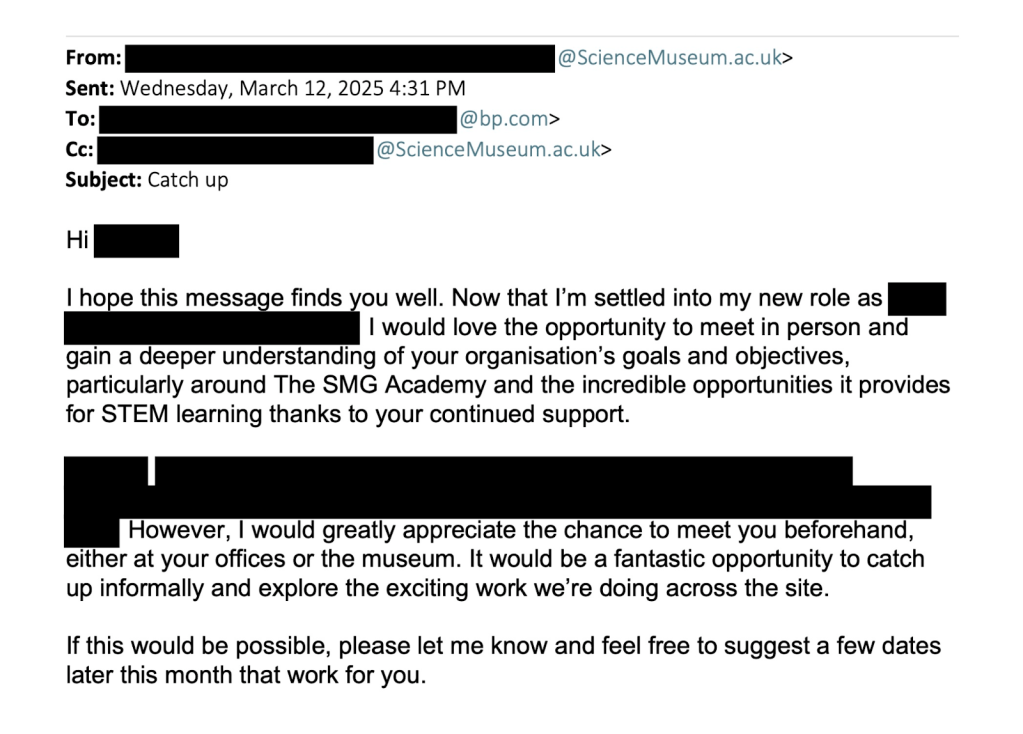
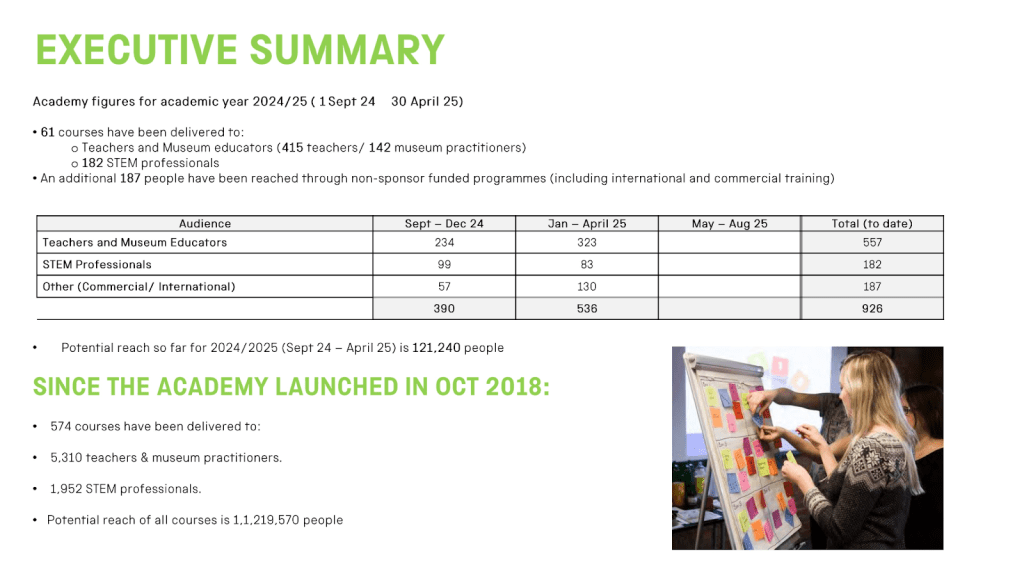
More significantly though, project updates provided to BP demonstrate the significant scale of the Science Museum Group Academy’s engagement, with its total reach up to May 2025 involving:
“574 courses to 5310 teachers & museum practitioners (415/142), 1952 STEM professionals, potential total reach of 1,129,570 people”
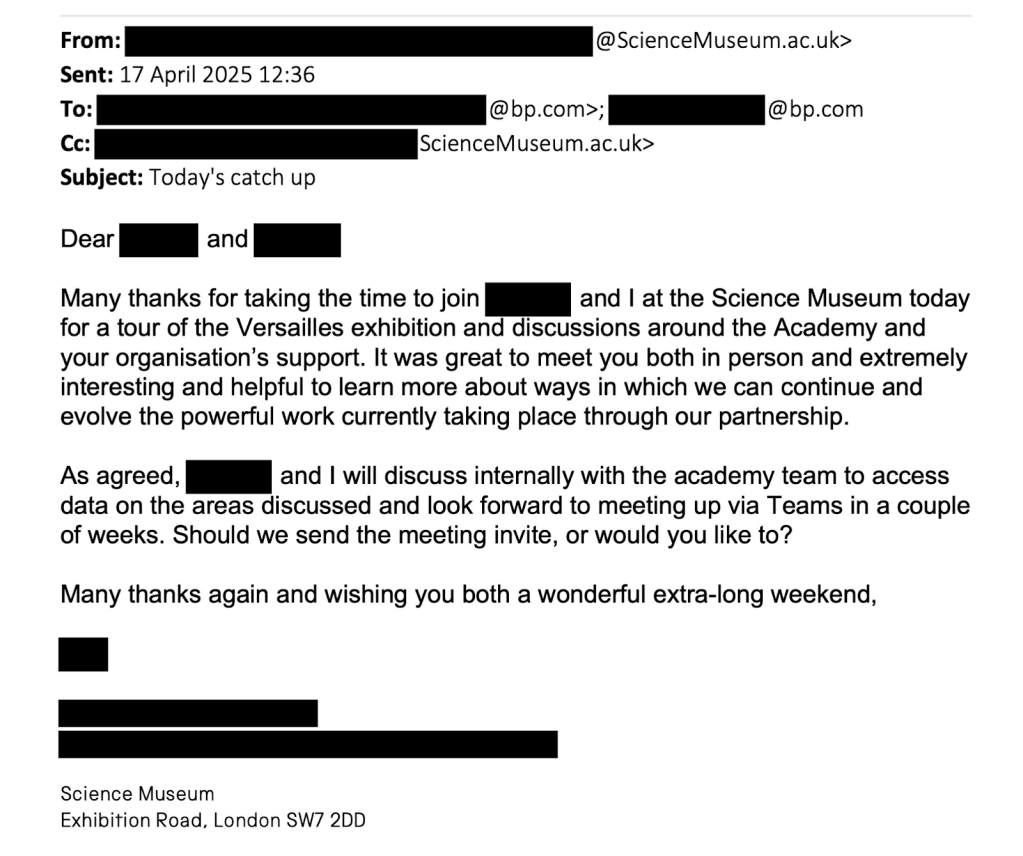
Emails from April-May 2025 demonstrate BP’s preoccupation with key performance indicators and other impact measures, offering to talk museum staff through its own approach to ‘collecting data insights’. This exchange speaks to the transactional nature of BP’s partnership with the museum, with the company wanting to measure what it is gaining from its investment – and according to its own methodology.
In an email on 17 April 2025, a member of staff at the museum says to BP that:
‘It was great to meet you both in person and extremely interesting and helpful to learn more about ways in which we can continue and evolve the powerful work currently taking place through our partnership.’

BP’s fixation on these figures speak to BP’s broader ‘social licence’ strategy to strengthen its engagement and advocacy to influence policymakers from the position as a ‘champion of STEM education’ (as we examine in Part 5).
2. The Enterprising Science Project
The origins of the Science Museum’s Science Museum Group Academy were deeply enmeshed with BP and its own interests as a fossil fuel company, with the company expecting – and being granted – a high level of control and input. The project originated in ‘Enterprising Science’, a 5-year research and development partnership between the Science Museum Group, University College London, King’s College London – funded by BP, which paid £4.3 million towards the research project.
On the Science Museum’s website, the project is described in the following way:
“[the] project used the concept of science capital to understand how young people from all backgrounds engage with science and how their engagement might be supported.”
It continues:
“The Science Museum Group provided practitioner-based expertise about outside classroom learning. [They] developed tools and approaches to apply the science capital research to operational practice for the informal science learning sector to maximise the impact of STEM engagement for the widest possible audiences… Enterprising Science was underpinned by evidence-based research carried out by University College London and King’s College London.”
The description gives little indication of the scale of BP’s involvement or the role it played. In a blog defending the museum’s approach to corporate partnership, Director Ian Blatchford also set out how the Science Museum Group Academy builds upon the Enterprising Science project, but with bp again only framed as the ‘supporter’ of the researcher rather than a partner in it and with the significant level of say over its direction.
3. BP calling the shots
Outwardly, the project was portrayed by the Science Museum as a standalone research project, where the money paid by BP merely formed part of its existing ‘corporate partnership’ with BP was simply a funder of the research.
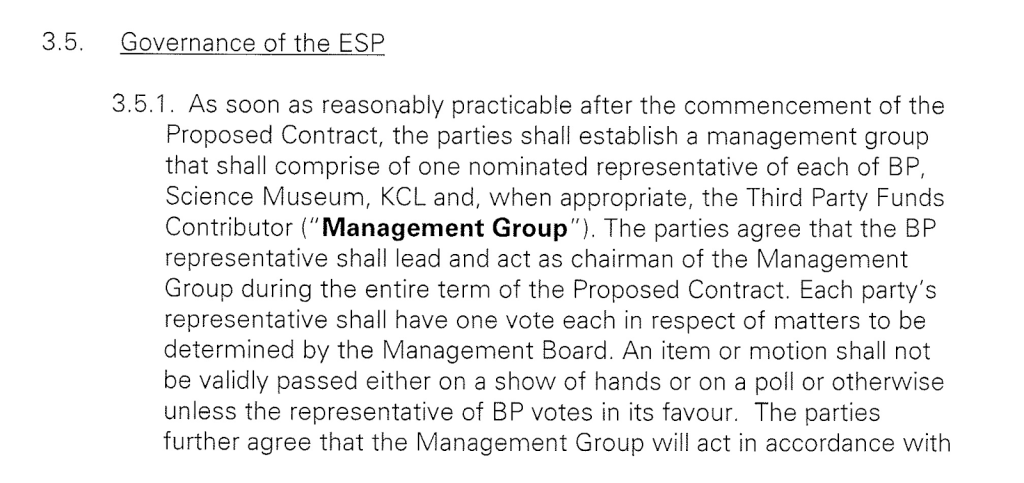
But the reality was very different. The contract for the ‘Enterprising Science’ research project sets out how BP would play a central role:
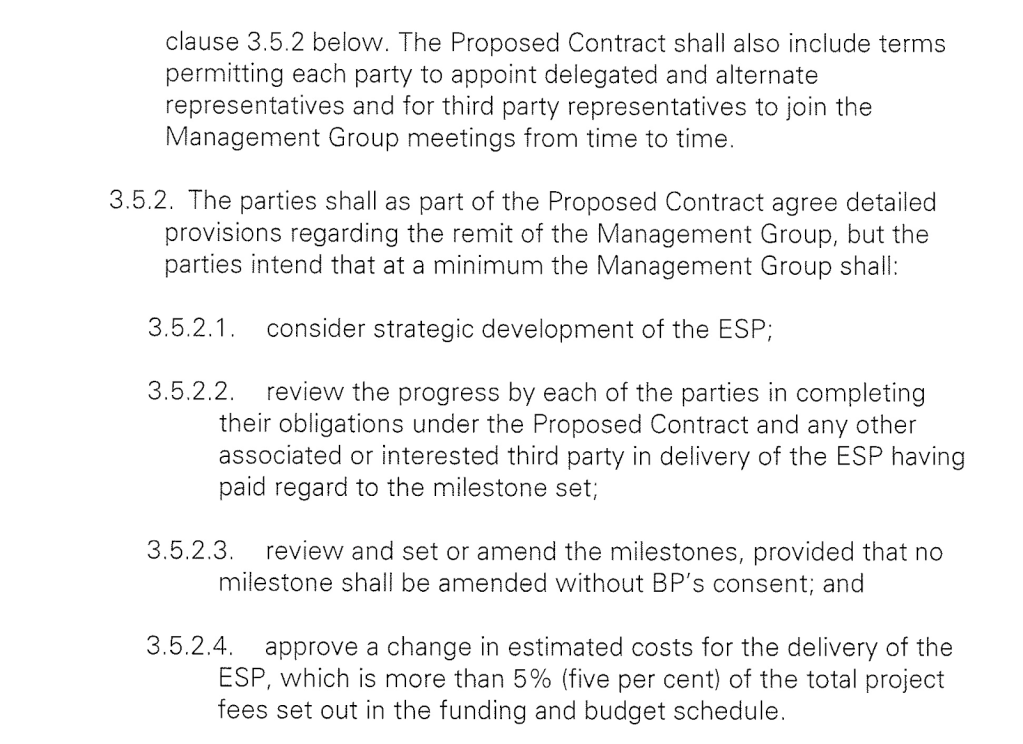
‘…The parties agree that the BP representative shall lead and act as chairman of the Management Group during the entire term of the Proposed Contract.”
[See p7, 265.17 – Annex A – Contract.pdf]
The agreement went further still, specifying how BP’s representative had the power to effectively veto any decisions taken by the project’s Management Board that weren’t to its liking:
“Each party’s representative shall have one vote each in respect of matters to be determined by the Management Board. An item or motion shall not be validly passed either on a show of hands or on a poll or otherwise unless the representative of BP votes in its favour.”’
With BP having signed new partnership agreements with the Science Museum Group in order to remain involved as the ongoing sponsorship of the Science Museum Group Academy, it has continued to use the association to boost its reputation and bolster its influence among educators and young people.
In addition, ‘science capital’ concept that emerged from the original Enterprising Science Project is one that resonates with BP’s interest in strengthening the recruitment pipeline to its business. While it’s unclear what direct input BP might have had into the concept itself, it is clearly one that resonated with, and supported, BP’s own agenda for STEM.
To give some illustration, Tom O’Leary, the Science Museum Group’s Director of Learning remarked in 2015 how:
“The powerful concept of science capital can change the practice of the Science Museum Group and potentially that of many people involved in informal science learning.”
For more, see (6).
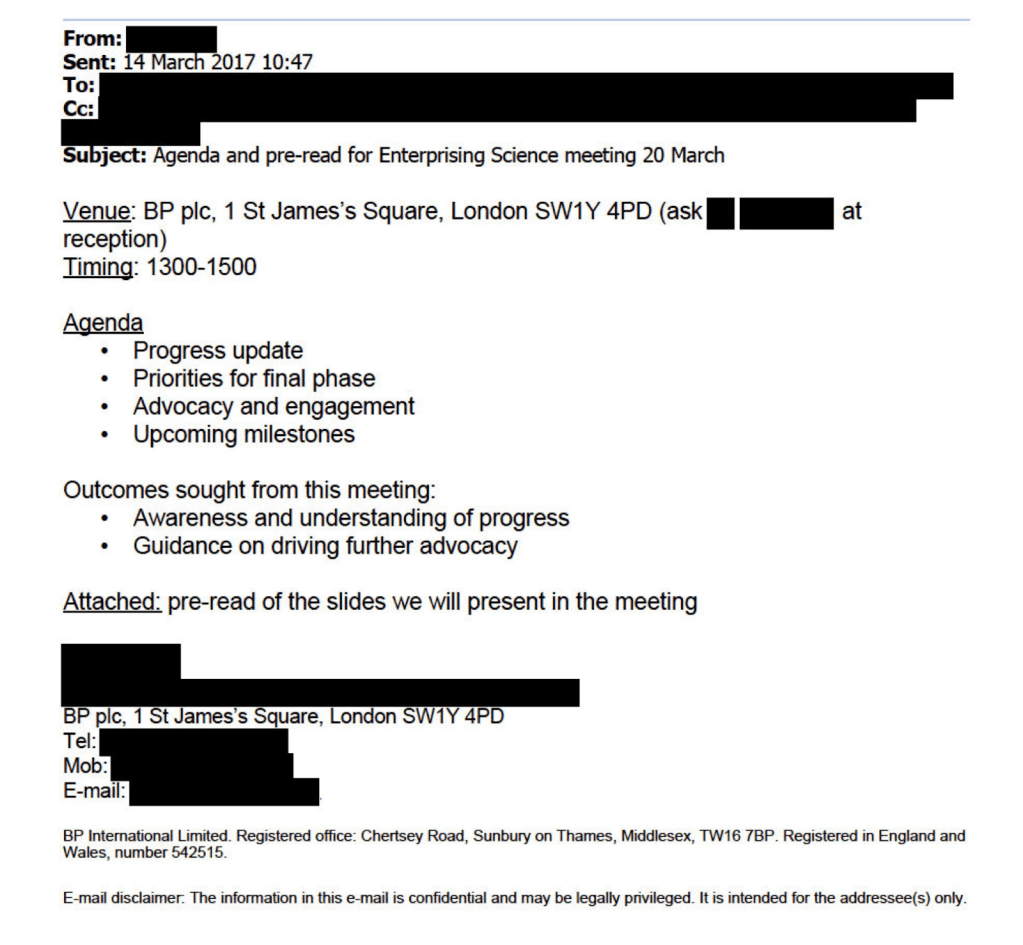
Emails sent during the ESP project also demonstrate BP squarely holding the chairing role for the management group, sending around the agenda for a meeting at its HQ to discuss the final phase of the project, including ‘Guidance on driving further advocacy’.
4. A Faustian Pact
On 9th October 2015 – just a few years after BP had been ordered to pay billions in criminal fines from its Deepwater Horizon disaster – the Science Museum decided to hold a seminar to share some of the initial research findings from the ‘Enterprising Science’ project, entitled ‘Transforming practice: Science capital seminar at the Science Museum’. Alongside Kings College London, UCL and the SMG, BP was one of the presenters at the seminar and its logo emblazoned the presentation and project report. Far from being a hands-off funder, the project was clearly allowing BP to clean-up its image and position itself as a relevant and trusted voice on STEM education despite its dire climate and environmental record.
The formal contract, once again, reveals how BP had cemented its control over these kinds of research outputs – and even after the project itself had concluded. It specifies how:
“The parties acknowledge the unique contribution of BP to ESP [Enterprising Science Project]. Science Museum and KCL agree that the Proposed Contract will contain restrictions on Science Museum and KCL with respect to duplicating this programme within the energy sector with involvement of BP competitors. The Proposed Contract will set out the distinctive characteristics of ESP which [the] Science Museum and KCL may not duplicate.”
Far from seeking to support STEM education research and training undertaken by two of the country’s leading research institutions, BP was clearly concerned with leveraging a publicly funded museum and university for its own gain – and then controlling how the findings could then be used. As the agreement states:
“It is the intention of the parties that BP should own the intellectual property rights in the Programme Identity.”
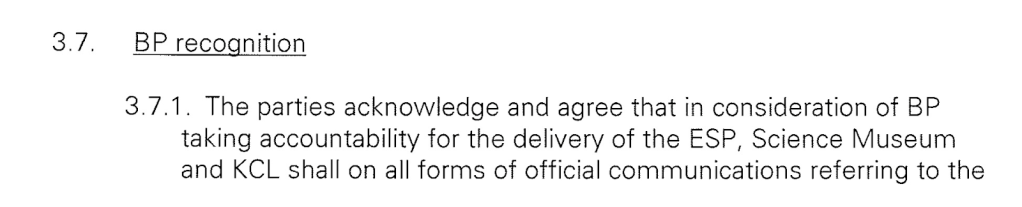

[See p10-11, 265.17 – Annex A – Contract.pdf]
5. Leveraging impact and engaging government
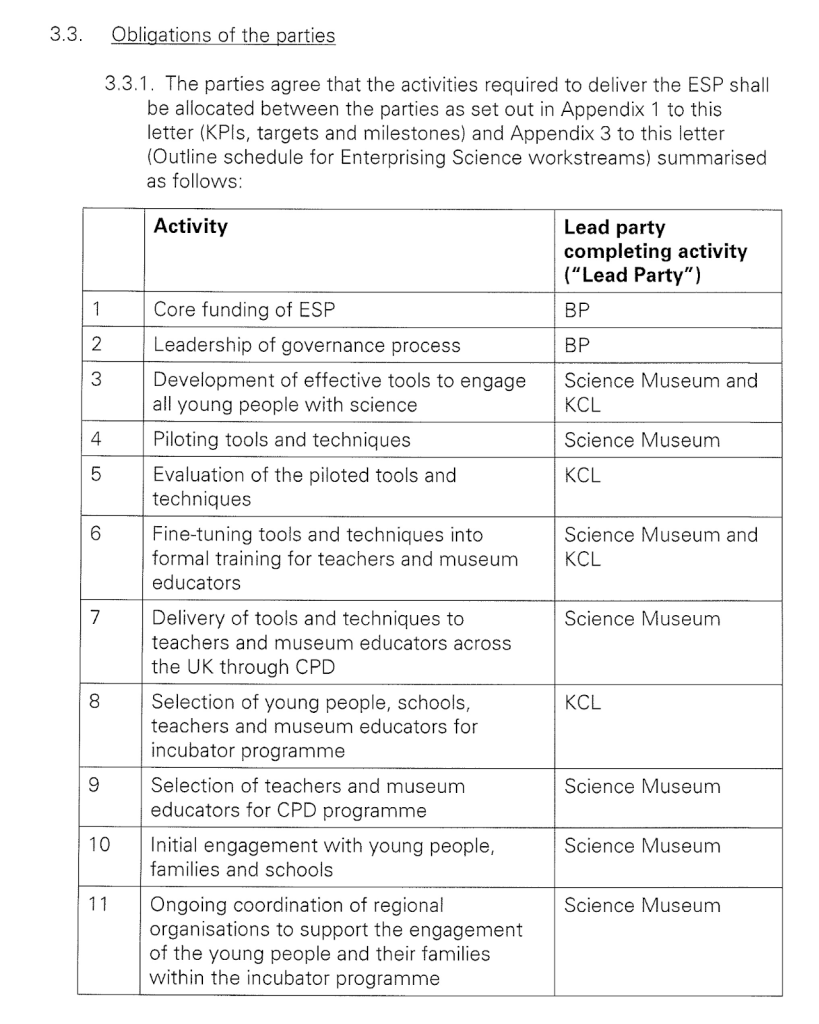
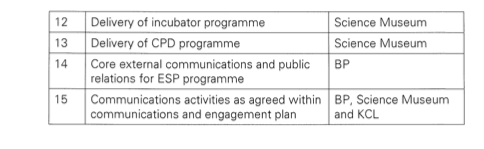
In addition to having a controlling vote in decision-making and ownership of intellectual property rights for the foundational ‘Enterprising Science’ project, BP’s influence went further still. A table within the formal agreement letter, setting out the terms of the contract, makes BP’s influential role and its ability to leverage the project in order to benefit its own social licence all too clear.
It specifies how BP would have sole responsibility for:
‘core funding’
‘leadership of governance process’
‘core external communications and public relations for ESP programme’
However, the Science Museum Group stated in a previous FOI response that, “BP’s main role is to provide funding to enable the research to happen and to ensure that there is regular communication between our two institutions”. On the Science Museum’s webpage on Enterprising Science, it merely describes the project as having been “supported by BP” and gives no indication of the level of input and control BP had over the project.
A letter disclosed by the Department of Education shows that BP stepped fully into its ‘core external communications’ role, writing to the department – which housed the National College for Teaching & Learning – to request its engagement and consultation on the project. BP was clearly not just the funder of the project, as the museum had suggested, but was actively using it to further its own influence and engagement at a high level.
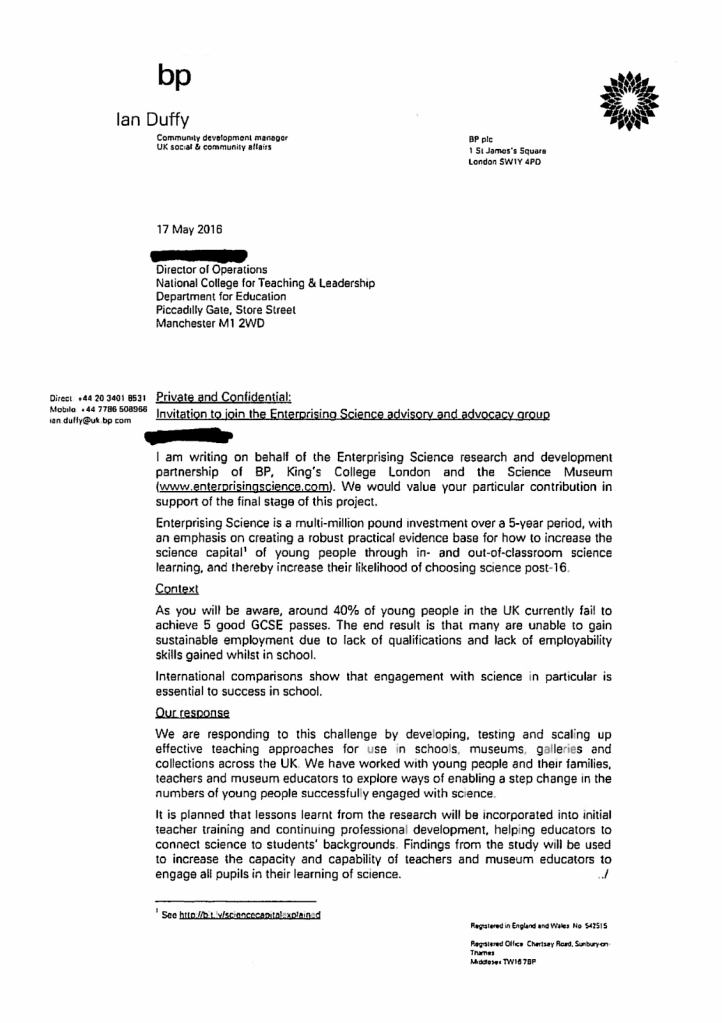
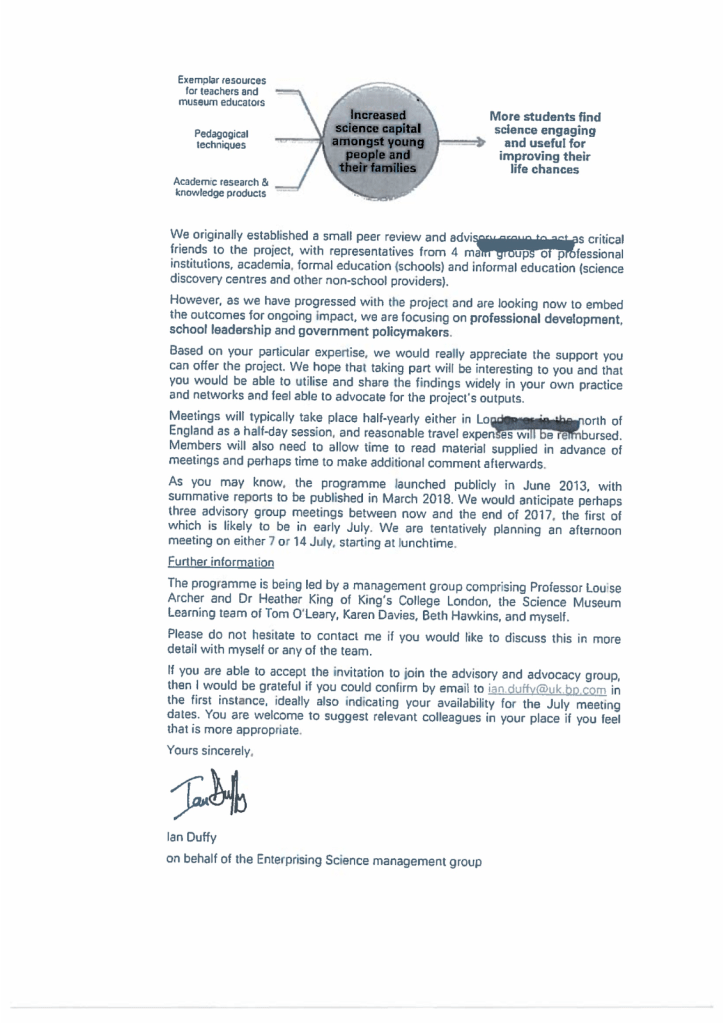
[See Letter from Ian Duffy, BP to Department for Education]
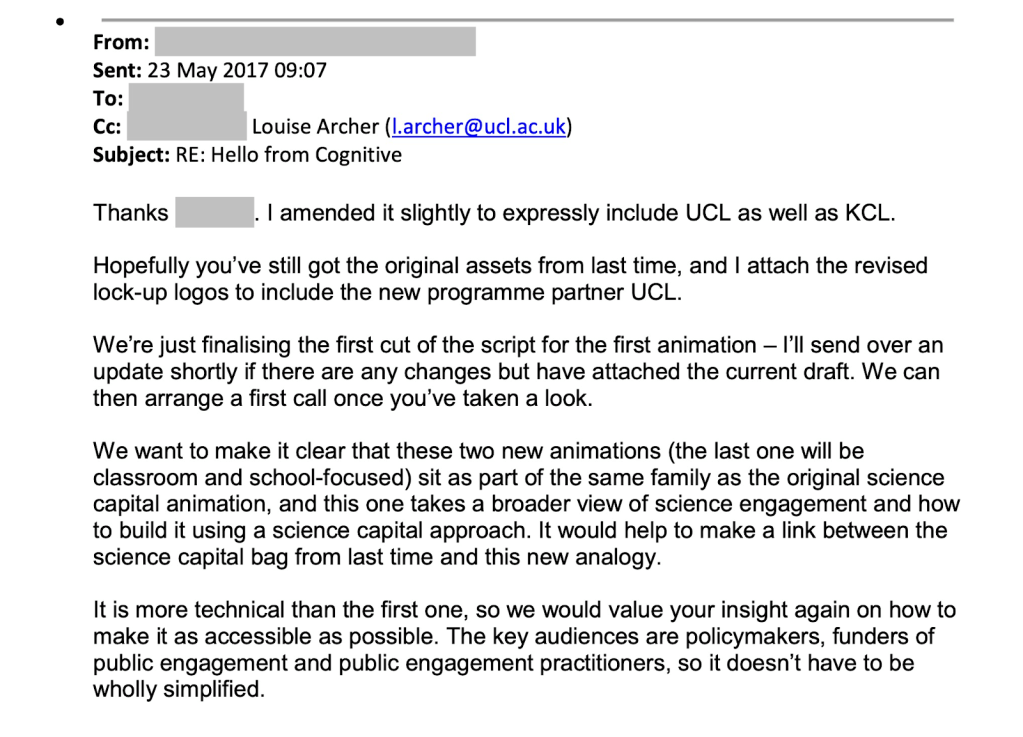
An email from BP to project partners on 23 May 2017 sheds further light on how the company saw Enterprising Science as an opportunity for strengthening its engagement and advocacy to policymakers. It sets out how it was commissioning two animations, the second ‘takes a broader view of science engagement’ and ‘how to build it using a science capital approach’, where ‘the key audiences are policymakers, funders of public engagement and public engagement practitioners…’
In a separate correspondence chain – with the subject line ‘Science capital plan’ – there is a message that explicitly suggests that members of what was then the Department for Business, Energy & Industrial Strategy had attended a meeting at BP’s office about the project. Beyond this, the contents of the email are redacted but it clearly points to the Enterprising Science Project being a vehicle for BP’s direct lobbying of, and engagement with, the government of the day.
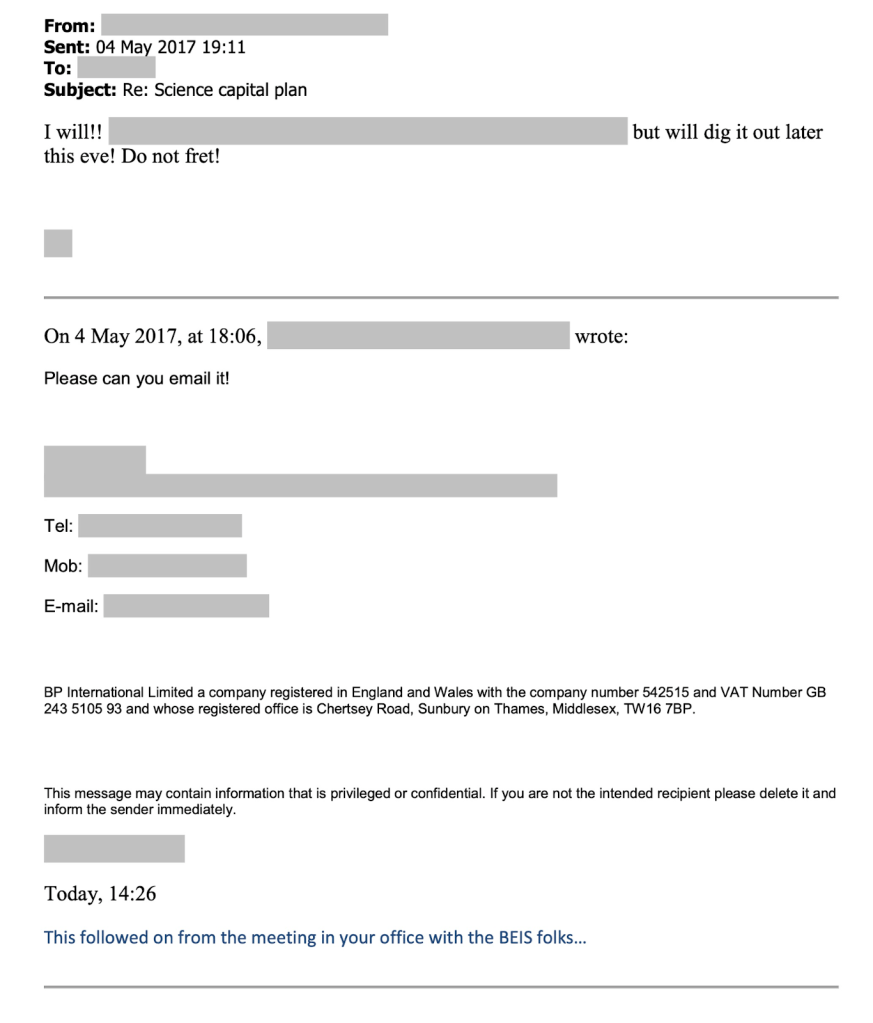
These FOI disclosures make clear that BP played a central role in the Enterprising Science Project, one that now underpins an extensive STEM teacher and educator training programme at the Science Museum – the Science Museum Group Academy – which BP sponsors today.
6. Providing pupils with a “BP context for their learning”
Significantly, BP made a formal submission to a UK Parliamentary Committee in 2017 in order to promote its involvement in STEM, with ‘Enterprising Science’ central to it. It openly states that one of the ‘desired outcomes’ of the project – alongside BP’s other STEM initiatives – is to provide pupils with ‘industrial and BP context for their learning’.
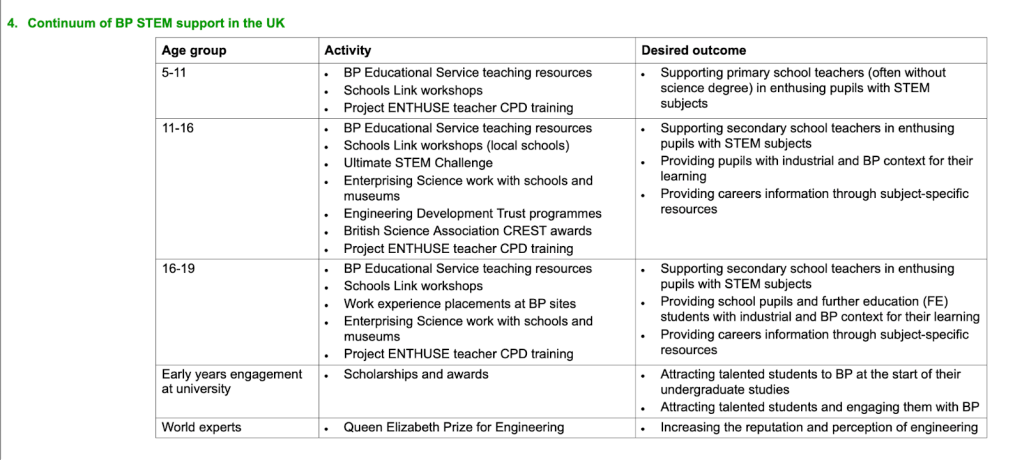
Subsequent scholarship and award programmes at the university level are then designed to capitalise on this and attract ‘talented students to BP at the start of their undergraduate studies’ and engage them with BP.
The submission paints a clear picture of BP leveraging its partnership with the Science Museum, KCL, UCL and others, in order to shape its perception among young people and strengthen its own recruitment pipeline.
However, a recent investigation by the climate news outlet DeSmog goes further. It looked into internal BP memos that were disclosed following a US Congress Investigation, documents that shed new light on BP’s cynical use of STEM and education initiatives in order to extend its influence.
Far from just seeking to promote itself to young people, internal documents from 2016 showed how BP sought to leverage these STEM projects as a way to enhance its own public profile and mitigate against negative impacts. As DeSmog reported:
“[BP America’s Communications & External Affairs] team was told to mitigate the potentially harmful impact of “detrimental policy and political developments” by “leveraging our distinctive position as a champion of STEM education” as well as demonstrating the company’s “commitment to communities,” through sponsorships, which were described as “focused community investments.”
7. BP and the curriculum: an insidious influence
Sponsorship of the arts, sport, science and education is an integral part of BP’s business strategy, a way to boost its brand, maintain its ‘social licence to operate’ and curry favour with significant policy makers and politicians.
BP’s STEM work has been, and remains, one of the major planks of the company’s “BP in the Community” strategy, which it also leverages to align itself with government priorities, promoting itself as “building capability for the future” by filling the ‘skills-gap’, boosting social mobility, tackling gender inequality, and providing employment and skilled jobs. It claims to have potentially reached one million students through these initiatives in 2024.
Its website reported that, in 2022, “1 in 4 primary schools and half of all secondary schools in the UK used free materials developed and provided by bp”.
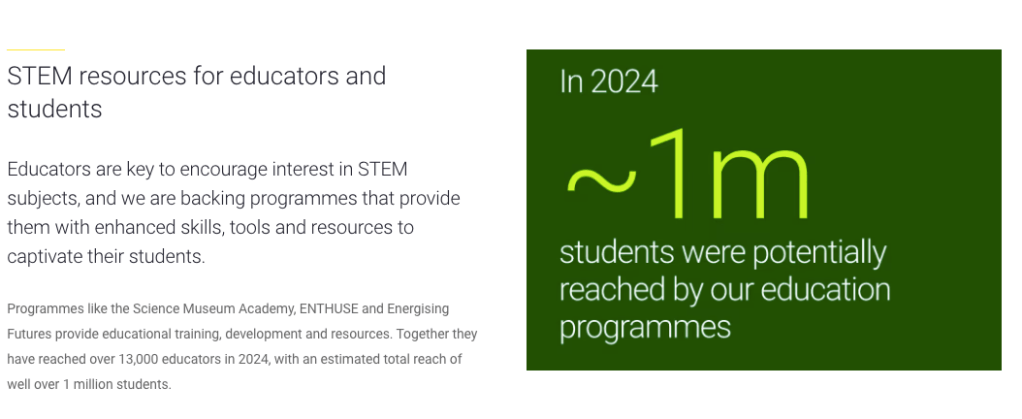
For many years, ‘BP’s Educational Service’ ran its ‘Ultimate STEM Challenge’ for school children in collaboration with – and hosted the prize ceremony at – the Science Museum. BP said in relation to the 2020 Challenge that:
“The competition has been developed based on insights from the ground-breaking ‘Enterprising Science’ research which shows that the more science capital (science-related qualifications, interest, literacy and social contacts) a young person has, the more likely they are to pursue a STEM career.”
Crucially, many of the competitions represented an explicit form of “greenwashing” by BP; on its website, BP said of the challenges it set for students in 2018 that they all “were designed to encourage students to think about how they could help to reduce natural resource use or bring down greenhouse gas emissions” and, in 2016, students were presented with the challenge of designing more streamlined oil tankers.

However, in 2023 BP appears to have abandoned its ‘Educational Service’ identity and fully rebranded its resources and activity in STEM as ‘energisingfutures.co.uk’ – where its own involvement is much less prominent and BP only appears to be named discreetly on the FAQs page. On the FAQs webpage for ‘Energising Futures’ BP makes the motivations for its involvement in STEM explicit, saying:
“Why does bp invest in education? bp want[s] to support the STEM skills development needed to create a diverse, high-quality talent pipeline for the future.”
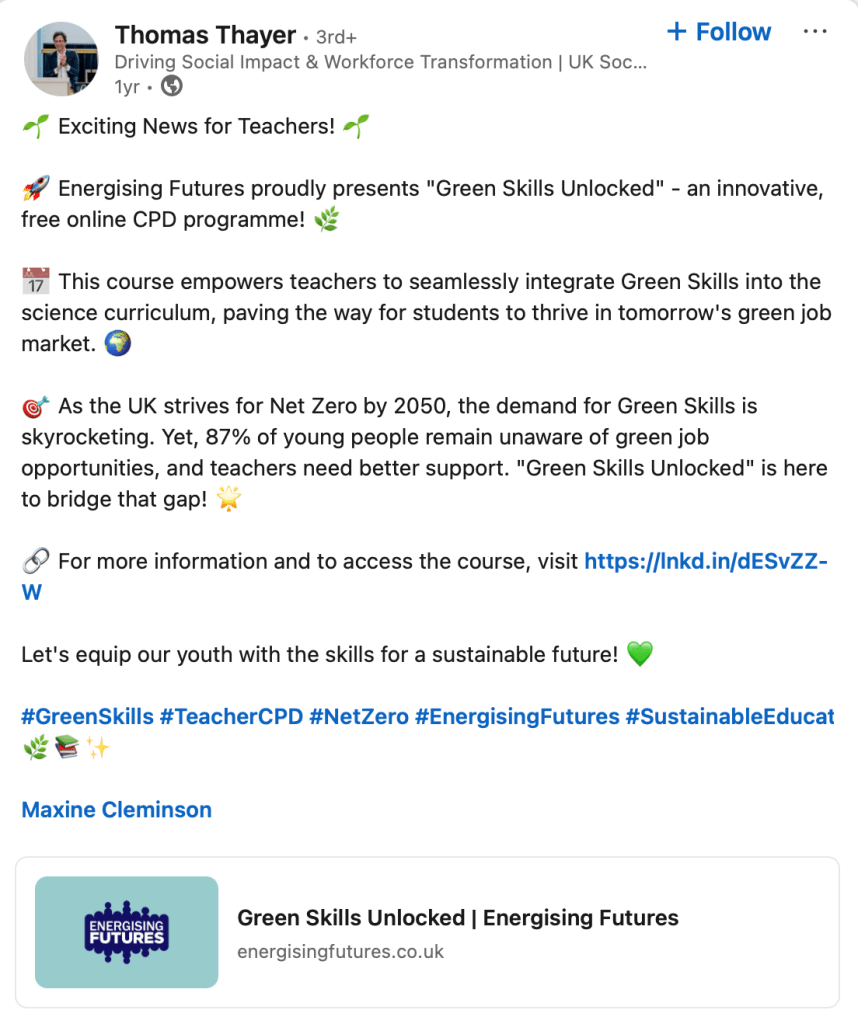
Rather than rely solely on the programme it sponsors at the Science Museum for training educators and teachers in STEM, BP – through its Energising Futures brand – has also mounted its own bespoke training programmes and events. Posting last year on LinkedIn, Thomas Thayer, UK Social Performance & Partnerships Manager at BP promoted the following event:
8. Science Museum acting as BP’s ‘enabler and defender’
The internal BP memos that were disclosed following a US Congress Investigation, and reported on by DeSmog, shed important light on how BP views sponsorship of museums and galleries, both as a way to both reach ‘high-level decision-makers’ and also to secure the backing of influential cultural and political figures who could then act, in BP’s own words, as its ‘enablers and defenders’.
This reinforces our own investigations over many years into the ways that BP has leveraged its relationship with the Science Museum Group in order to engage its reputation. The museum has notably aided BP in pushing the false narrative that it is ‘addressing the climate challenge’, with the Science Museum’s Director Ian Blatchfordrepeatedly insisting that, the major energy companies’ like BP ‘have the capital, geography, people and logistics to be major players in finding solutions to the urgent global challenge of climate change’ – even as these companies continue to ramp up investments in new oil and gas drilling.
In an extensive interview with the FT in 2022, Blatchford vocally defended BP:
“Blatchford believes BP is different. Not only does it fund research into green technologies, he says, but most importantly it is a publicly listed company whose corporate strategy is under scrutiny from investors. A push to delegitimise such companies will only drive fossil fuel activities further into the private sphere which operates in the shadows…”
Prior to that, in 2019, Blatchford told the FT that:
“Even if the Science Museum were lavishly publicly funded I would still want to have sponsorship from the oil companies.”
Our own past investigations have shown how Ian Blatchford and other leaders at the Science Museum have made repeated efforts to defend BP and its sponsorship, both internally to staff and to the public. For example, we know that in 2019 on the day that BP was telling civil servants it had been ‘disappointed by the criticism’ it had been receiving over its arts sponsorship, Blatchford had arranged an ‘informal chat’ with BP to discuss exactly that issue. BP would later be invited in to present and defend its business activities to museum staff and trustees in sessions billed as:
“An opportunity to understand why the energy sector sponsors cultural organisations.”
To find out more, visit: https://cultureunstained.org/smgdefendsbp/
9. BP breaches the Science Museum’s sustainability criteria – but has it created a loophole?
In the contract with BP for its sponsorship of the ‘Science Museum Group Academy’ in 2023, the Science Museum set out its Sustainability Criteria for corporate sponsors, such as BP, in the following way:
“SCMG requires all prospective and current partners to achieve the following on the TPI Tool: (i) ‘Level 4 or better’ on the TPI Tool’s ‘Management Quality Index’ no later than 31st March 2023; and (ii) alignment with the Paris 1.5 degree pathway on TPI Tool’s Carbon Performance Index no later than 31st March 2024 (together the “Indices”)”
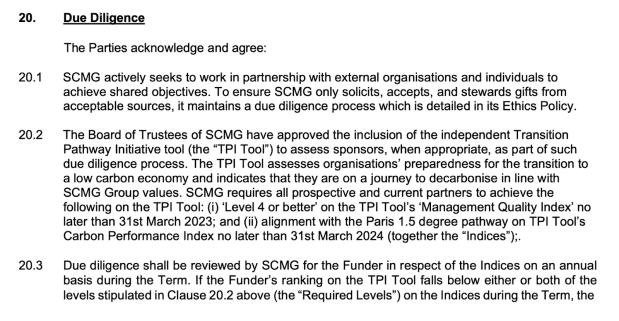

TPI scores for BP both at that time – and, crucially, in March 2024 – showed that BP was not aligned with a Paris 1.5 degree pathway over the short-term (to 2027) or medium-term (to 2035) and was in breach of that threshold.
However, the Science Museum has now retroactively claimed that its criteria had only required sponsors to achieve long-term alignment (to 2050) – effectively providing BP with a loophole to remain a museum sponsor. The wording of the Sustainability Policy on the website has now notably shifted from the above, to now say:
‘We ask all current and prospective partners in the energy sector that are involved in fossil fuel extraction to: Achieve Level 4 on the TPI Management Quality index (TPI rates companies from 0 – 5) and to achieve long-term alignment with the Paris 1.5 degree pathway on TPI’s Carbon Performance index.’
With BP having now abandoned any pretence of climate goals and committing to further oil and gas extraction, BP will almost certainly fall short of the Science Museum’s sustainability criteria in either form. Given the limits set out by BP in the original contract for the Enterprising Science Project, it raises questions about the future of the Academy and the museum’s ability to use the ‘Enterprising Science’ content into the future.
Sources
EPP transforming practice conference report
KCL UCL Progress report March 2017
KCL UCL Progress report May 2017
FOI-2017-025-1 Corporate Membership Benefits
FOI-2025-048: 2025 Correspondence with BP (BP Family Day)
 Culture Unstained