
Today, internal documents from BP have been made public which uncover the oil company’s ‘cynical strategy’ for sponsoring art and culture. The internal memos show how far from seeking to generously support the culture sector, BP had sought to use sponsorship of museums and galleries as a way to both reach ‘high-level decision-makers’ and secure the backing of influential cultural and political figures who could then act, in BP’s own words, as its ‘enablers and defenders’. The revelations come just weeks after the Director of the BP-sponsored British Museum mounted an outspoken defence of his stance on corporate sponsorship and as BP abandoned its climate goals and committed to ramping up its production of polluting fossil fuels.
The internal documents, which have been published and reported on by the investigative journalism outlet DeSmog, shine a damning spotlight on BP’s efforts to use the arts both to promote its brand and extend its influence over politicians during the past decade.
- A memo from 2016 spells out how BP believed its strategic relationship partners could be ‘powerful 3rd party advocates for issues that are critical to our business’.
- It also highlights how ‘Direct benefit’ for BP ‘comes when our partners engage as influencers, supporters or defenders on regulatory, legislative, or other policy matters’, and that, ‘indirect benefits comes (sic) in our ability to access the network and platform provided by our partners to deliver our messages.’
- The memo also makes clear that far from acting to support the culture sector, BP’s ‘Target’ for its sponsorships was to ‘secure public support and advocacy from partners to mitigate risks and advance business interests.’
- Most disturbingly, the memo identified what BP refers to as a ‘stretch goal’ for these sponsorship deals – to ‘leverage strategic relationships to mitigate potential litigation or other sensitive matter (sic).’
- A separate ‘key messages’ document also set out how BP’s sponsorship of arts and culture should be communicated alongside its then desire to be seen as ‘a fossil fuel company that is playing its part in addressing the climate challenge’.

These documents add significantly to the growing body of evidence of BP’s calculated use of cultural sponsorship designed to further its core oil and gas business. Investigations and Freedom of Information (FOI) disclosures secured by the campaigns organisation Culture Unstained since 2016 clearly demonstrate how the strategy in BP’s internal memo was put into action, including;
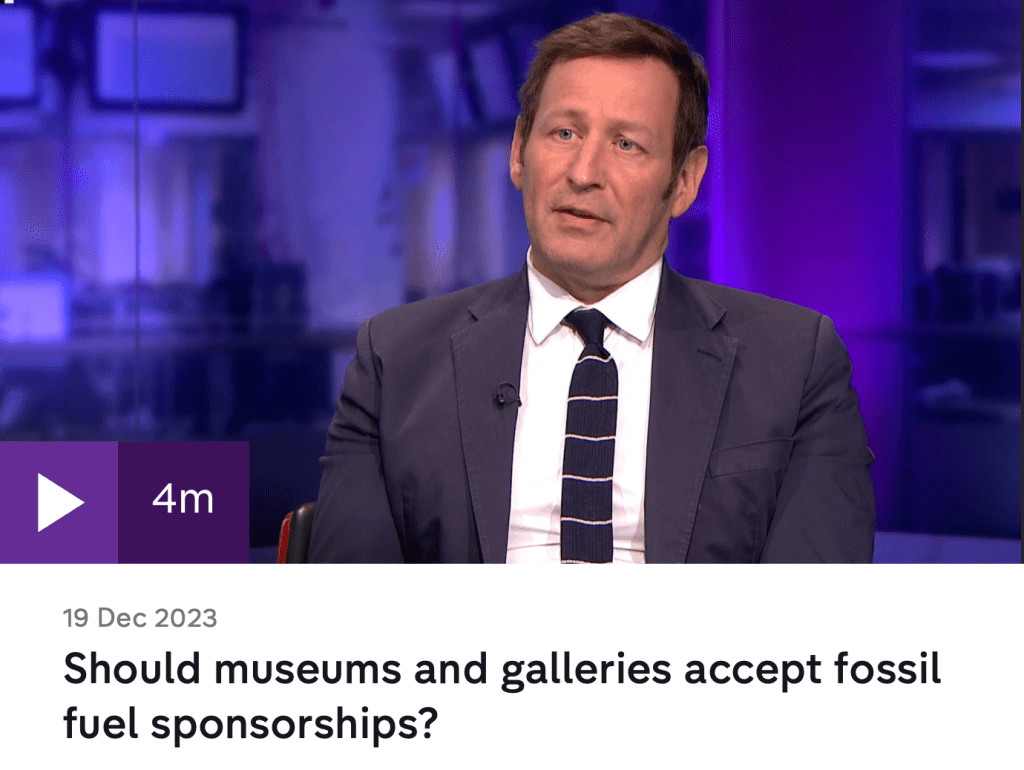
- Click here to see how BP used sponsorship to leverage enablers and defenders, including prominent politicians defending the company, most notably former UK Culture Minister Lord Ed Vaizey appearing across the mainstream media to vocally defend BP’s new 10-year sponsorship deal with The British Museum as a backlash to the deal unfolded; as well as the Director of the then BP-sponsored Tate galleries Nick Serota memorably remarking, following BP’s Deepwater Horizon disaster, that, ‘you don’t abandon your friends because they have what we consider to be a temporary difficulty’.
- Click here to find out how sponsorship helped BP to push the myth that it is “addressing the climate challenge” – such as the Science Museum’s Director and Chair repeatedly insisting that, “the major energy companies” like BP “have the capital, geography, people and logistics to be major players in finding solutions to the urgent global challenge of climate change”, even as they continue to ramp up investments in new oil and gas drilling.

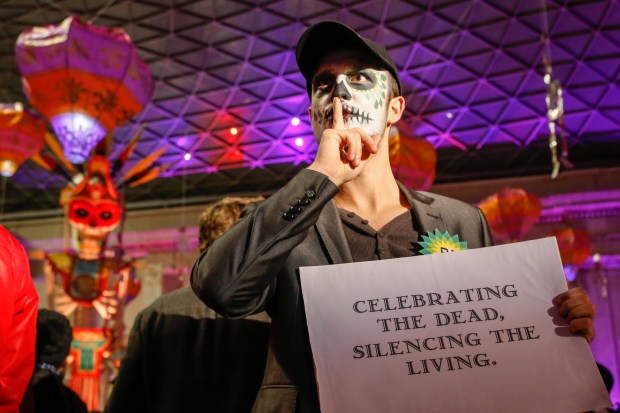
- Click here for evidence of how BP reached decision-makers thanks to its arts sponsorship deals – such as a one-off ‘Day of the Dead’ event at The British Museum in 2015 where BP hosted a VIP reception with Mexican policy-makers, later securing new drilling licences from the Mexican government. BP’s Vice President later admitted to The Times that, ‘When there is an option, naturally we are going to try to match a particular exhibition with somewhere we have [a business] interest.’
- Click here to see how sponsorship has helped BP to mitigate criticism and the impacts of litigation – such as strategically sponsoring cultural projects between the UK and Russia – even after the annexation of Crimea – to positively frame BP’s stake in Russian state oil company Rosneft and deflect from its close links to President Vladimir Putin.
On the memo’s characterisation of culture leaders as ‘enablers’ and ‘defenders’ of BP, a spokesperson from the research and campaign group Culture Unstained, has commented:
“BP’s damning internal memos make it crystal clear: oil sponsorship is a toxic transaction designed to deceive, not some generous donation to the arts. By sponsoring our museums, theatres and galleries, BP had sought to transform these iconic cultural institutions into spaces where it could advance its destructive and polluting business plans, with museum leaders cast in the roles of – to use BP’s own words – its ‘enablers’ and ‘defenders’.
Now that BP’s cynical sponsorship agenda has been laid bare, there are urgent questions for the Directors of The British Museum and Science Museum to answer, as cultural leaders who have continued to defend and back BP even as it has doubled down on fossil fuel drilling – and as the wider cultural sector has turned its back on fossil fuel funding.”
After BP was issued with record breaking criminal and environmental fines following its Gulf of Mexico oil spill and scrutiny of its business intensifying in the face of growing climate change, these documents confirm that the company actively engaged in a strategy that would seek to limit future damage to its brand and potentially shape its perception among regulators and litigators. Now, as BP increases its investments in oil and gas, the UK museums it sponsors have continued to act as ‘enablers and defenders’ by giving strong public backing to their partnerships with BP, amid widespread condemnation of the company’s backtracking on emissions reduction aims.
Currently, BP is subject to legal proceedings from Gazans based in the UK who have lost family in the Israeli attacks on Gaza, who claim that BP’s supply of oil to the Israeli military makes the company complicit in war-crimes, and the claimants demand that BP is held accountable. Jonathan Purcell, Senior Public Affairs and Communications Officer at International Centre of Justice for Palestinians which is supporting with this case, reacted to the disclosed documents:
“Greenwashing, sportswashing, artswashing – BP is no stranger to using every trick in the book to sanitise its agenda. It is more concerned with fighting a PR War than stopping to think why it faces so many legal challenges in the first place.
From its climate-wrecking policies to its potential complicity in Israel’s genocide in Gaza, BP should concern itself with adhering to its own human rights policies and complying with international law, rather than worrying about the perception of its brand at places like the British Museum.”
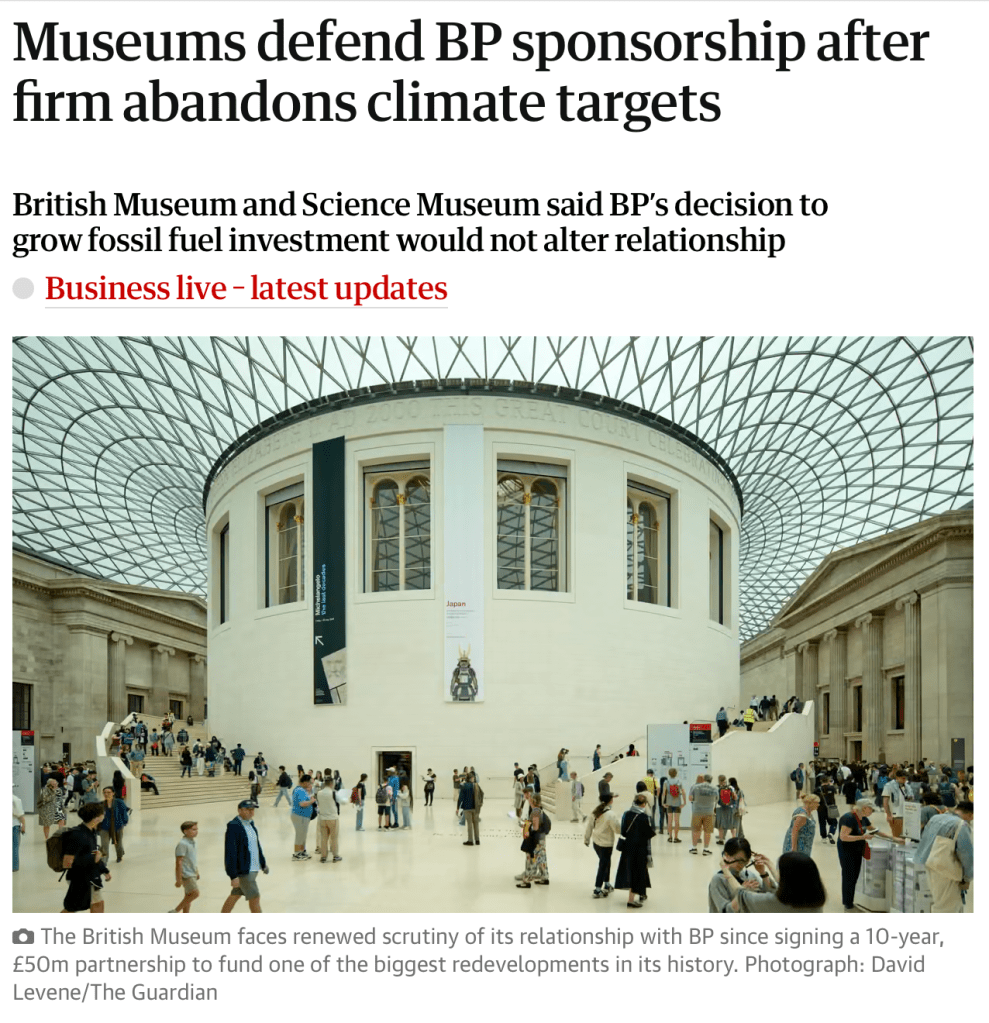
Since 2016, BP’s sponsorship deals with the Royal Opera House, Royal Shakespeare Company, National Portrait Gallery, Tate and the Scottish Ballet have all been ended as opposition to its sponsorship of the arts grew rapidly among artists, performers, workers and activists. However, BP’s new 10-year sponsorship of The British Museum, announced in 2023, and its ongoing partnership with the Science Museum for its STEM Academy have allowed the company to continue accessing influential networks and securing public support from the leadership of these taxpayer-funded cultural institutions.
LINKS TO DOCUMENTS
BP America Communication & External Affairs 2016 Plan
External Affairs memoFurther docs linked here see ‘Strategic relationships’ and ‘British Museum’ sections
- Sponsored institutions and their leaders acting as BP’s ‘enablers and defenders’
Multiple public figures, culture leaders and institutions have acted as BP’s ‘enablers and defenders’ due to its sponsorship of the arts in the UK. By praising BP publicly and in the media, they have helped to develop the misleading perception of BP as a generous philanthropist, giving the company valuable social and cultural legitimacy.
- At The British Museum, its Director Nicholas Cullinan has continued to perpetuate the myth that BP’s support is vital to keep the Museum entry free for the public, although its payments to the museum have only ever represented a very limited proportion of the museum’s income which could be secured from other sources. During his tenure, former Director Hartwig Fischer perpetuated a similar narrative, saying in 2019 that BP sponsorship helped to “create unique learning opportunities” and that “[BP’s support] is vital to [the museum’s] mission.”

- At the Science Museum, Director Ian Blatchford has been outspoken in his broad backing for BP and other fossil fuel sponsors, telling the FT in 2019 that, “Even if the Science Museum were lavishly publicly funded I would still want to have sponsorship from the oil companies.”
- Politicians and other culture leaders have also played a role in strengthening BP’s social legitimacy, including:
- Lord Ed Vaizey, former UK Culture Minister welcomed BP’s new sponsorship deal with the BM, telling BBC Radio 4’s PM programme: “We tend to treat BP as a pariah – BP has put a huge amount into the arts and has been treated very badly by some of the beneficiaries of that funding.”
- Lucy Frazer, former UK Culture Minister insisted: “I think we should say to BP, thank you. The ultimate beneficiaries of these sponsorships are all of us.”
- Baroness Thangham Debbonaire, former Shadow Secretary of Media Culture and Sport, criticised protests against BP at the British Museum as “pointless” and said “The private sector is more than capable of explaining what they are doing and be willing to listen to and discuss how they might do more”.
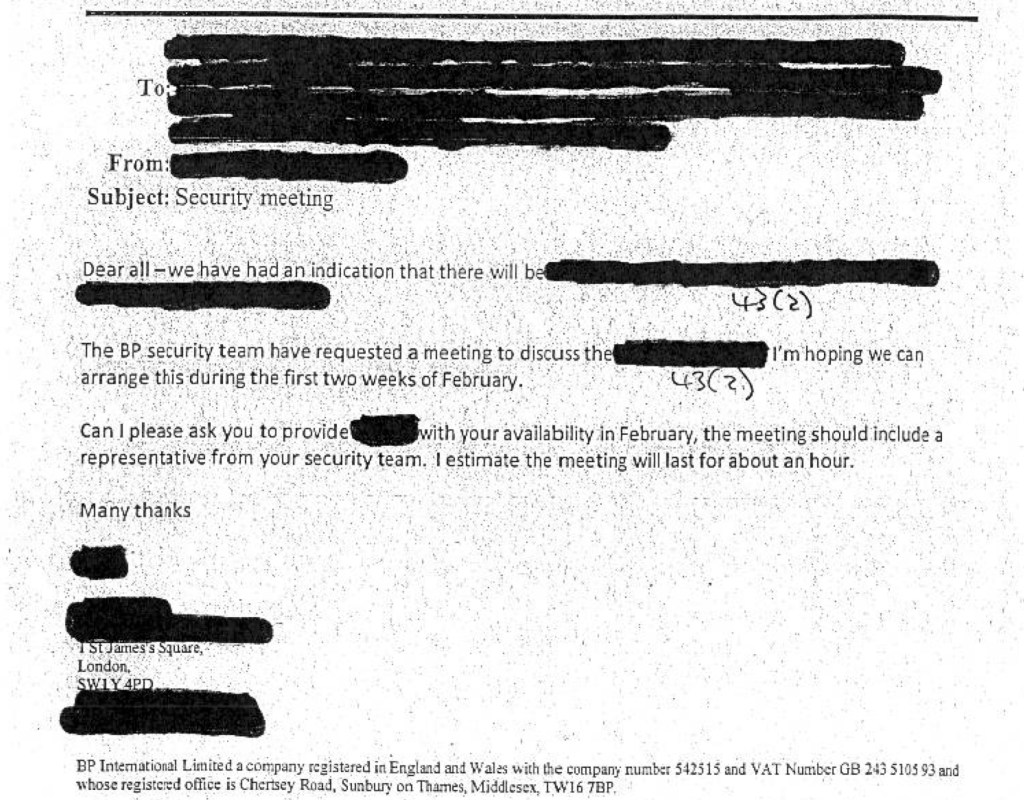
- Freedom of Information disclosures have previously revealed how BP sought to manage protests, convening a meeting at its London HQ in February 2015 to discuss ‘suggested measures’ for dealing with protests against its sponsorship of the arts with Heads of Security from The British Museum, Tate and other institutions it sponsored.
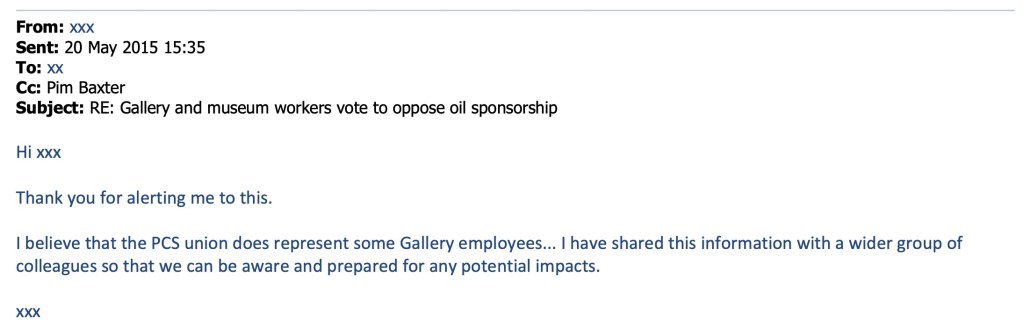
- When it was announced that the PCS Union, which represented front-of-house workers at many BP-sponsored cultural institutions was formally supporting the campaign against oil sponsorship in May 2015, BP wrote to the institution its sponsored asking, ‘Would be good to understand if there is an affiliation to this organisation within each of your respective establishments.’ To this, a member of staff at the National Portrait Gallery replied, copying in the deputy director of the gallery: ‘Thanks for alerting me to this. I believe the PCS Union does represent some gallery employees… I have shared this information with a wider group of colleagues so that we can be prepared and ready for any potential impacts.’
- Sponsored institutions promoting BP’s false narrative that it is “addressing the climate challenge”
- Both The British Museum and the Science Museum recently provided positive comments about BP after the company announced a ‘reset’ abandoning its ‘net zero’ goals and pledging to extract yet more oil and gas. Amid widespread condemnation of BP’s decision, a British Museum spokesperson commented that “corporate and private donations from companies like BP [are needed to] ensure that the magnificent collection stays on display to the public for centuries to come”. A Science Museum spokesperson called BP’s sponsorship: “vital to our mission to inspire millions of people every year”.
- BP’s £50 million 10-year sponsorship of The British Museum’s redevelopment plan was carefully messaged by the Museum, framing it as a means of “overhauling outdated energy infrastructure and replacing it with state of the art facilities that will dramatically reduce our carbon footprint.”
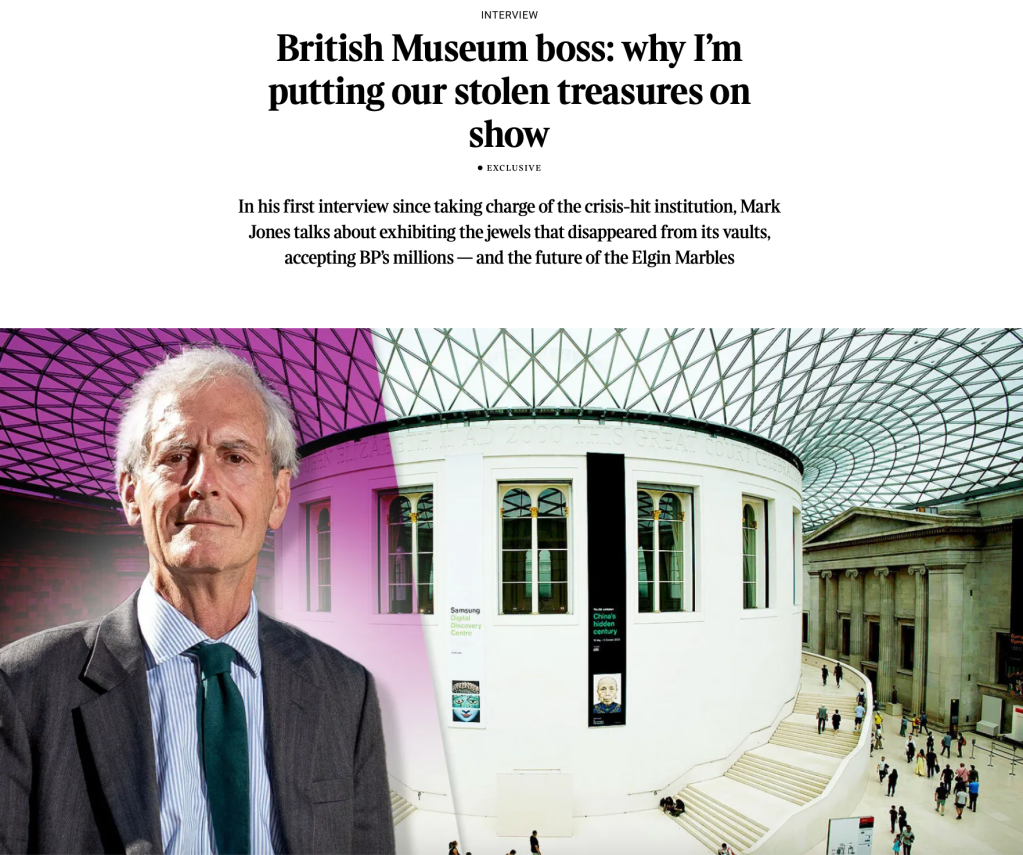
- In 2024, interim Director of The British Museum Mark Jones told The Times that, “If one is serious about dealing with climate change, as I certainly am, we have to recognise that it involves a transition. Oil giants like BP, which do derive their main revenue from fossil fuels, are also major agents of transition to the new technologies we need. If you look at BP’s investment, you see a major part of it now goes into green technologies. Why wouldn’t it? What is the future of such companies if not to transition?” The reality, even at that time, was that the vast majority of BP’s investments remained in fossil fuels and it had only made a series of limited, voluntary “net zero” aims which it has now reneged on.
- At the Science Museum, Director Sir Ian Blatchford, who has made sponsorship deals with oil companies BP, Shell and Equinor, and coal giant Adani, has repeatedly insisted that, “the major energy companies have the capital, geography, people and logistics to be major players in finding solutions to the urgent global challenge of climate change”.
- In his defensive internal memo to Science Museum staff, Ian Blatchford used the same language as this key messages document, saying fossil fuel sponsors like BP were “playing their part in addressing the climate challenge”. Over the course of June and July 2019, oil sponsorship was hitting the headlines as a series of high-profile figures spoke out. In response to this growing opposition – as well as mounting criticism of the SMG’s stance on oil sponsorship – the Director Ian Blatchford sent a lengthy – and highly defensive – email to the entire 1,300 workforce of the Science Museum Group on the 30th July 2019. In that email, he argued, “Whilst the global economy remains carbon intensive, the energy companies conduct extensive research into a wide range of new technologies to reduce our dependence, including carbon capture, fuel efficiency and alternative energy… I am very sceptical about the trite argument that such sponsorships are greenwashing.”
- With concerns growing among staff, two ‘Funder Q&A Sessions with BP’ were scheduled for November 2019, providing a dedicated opportunity for BP to defend its business directly to an audience of SMG staff. An invitation email makes the motivation behind the event clear: “This is an opportunity to understand why the energy sector sponsors cultural organisations”

- Sir Tim Laurence, Chair of the Board of Trustees at The Science Museum Group has also claimed that fossil fuel companies “have the resources to make the transition happen” – even as the Museum’s partners have continued to expand their fossil fuel extraction. He has also explicitly given legitimacy to the Museum’s fossil fuel sponsors by claiming that the Museum only engages with “companies if they demonstrate commitment to the development of renewable energy at scale and have plans that align with the Paris goals to limit global warming to around 1.5 degrees Celsius above pre-industrial levels by 2050” – despite expert analysis showing that, despite these companies’ claims of going net zero, “No major oil and gas producer comes close to being Paris-aligned”. Crucially, companies like BP are, in fact, regressing.
- For several years, BP hosted its ‘Ultimate STEM Challenge’ for school students in direct partnership with the Science Museum ‘delighted to be a partner’. Challenges often promoted and overstated BP’s efforts to curb climate change, such as asking pupils to design a more efficient oil tanker that would reduce the emissions produced from transporting fossil fuels.
- Despite not being currently sponsored by BP, some other museum leaders have also helped strengthen BP’s narrative of “addressing the climate challenge”. Tristram Hunt, V&A Director, has also been happy to emphasise BP’s good intentions, arguing in 2019 that, “I don’t have a problem with having relationships with those organisations, like for example BP who are thinking very carefully about a zero-carbon future.”
- Cultural sponsorship creating opportunities to reach ‘high level decision makers’
In 2016, BP’s former Vice President notably admitted in an interview with The Times, that “naturally we are going to try to match a particular exhibition with somewhere we have an interest”. This strategy has clearly played out at both The British Museum and The Science Museum.
- Since 2010, BP put its name to three major exhibitions on Egypt at The British Museum while its total investments in Egypt doubled over this time, dramatically expanding fossil gas production. In 2022, Egypt’s ambassador to the UK said “..we thank our partners in the UK, such as BP, for working with us in utilizing our resources to develop our economy and through such an exhibition unraveling our history as well.” The most recent exhibition on Egypt at The British Museum opened just months before the country hosted the UN Climate Summit.
- BP sponsored the British Museum’s ‘Indigenous Australia – Enduring Civilisation’ exhibition in 2015, while it was pushing controversial plans to drill in the Great Australian Bight. Documents disclosed in response to Freedom of Information (FOI) requests suggest that the museum was involved in a pre-launch public relations strategy for the Australian high commission in London and also failed to inform the vast majority of Indigenous communities connected to the exhibition that BP would be the sponsor. BP’s proposed plans to drill in the Great Australian Bight were being opposed by the Mirning Traditional Owners at that time.
- BP sponsored a Mexican ‘Day of the Dead’ festival at the British Museum ahead of bidding for new drilling licences in the Gulf of Mexico. During the event, BP hosted a VIP reception upstairs in the museum where the invitation list included the Ambassador of Mexico and members of the Mexican Government.
- At the Science Museum, BP was principal funder of the Museum’s ‘Cosmonauts’ exhibition when the company had a 19.75% stake in the Russian state-owned oil and gas company, Rosneft. Emails showed BP trying to shift the exhibition launch date away from days when “you’d struggle to engage senior officials” in Russia. BP’s then CEO Bob Dudley personally invited John Whittingdale, then Secretary of State for Culture, Media and Sport, to the launch dinner.
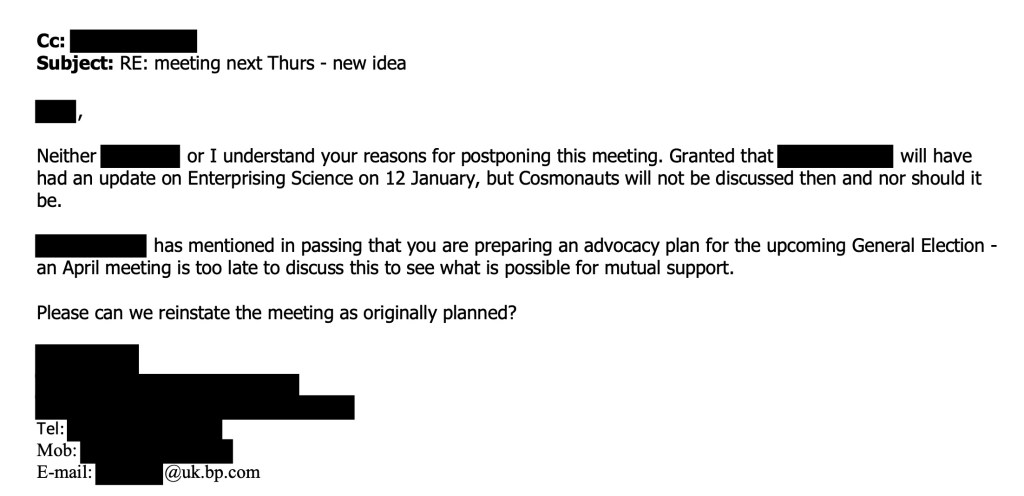
- An FOI request by Art Not Oil also revealed how, ahead of the UK 2015 General Election, a member of Science Museum staff attempted to reschedule a meeting with BP in which an ‘advocacy plan’ for the May election was to be discussed. In reply to this email, BP makes its priorities clear: ‘Neither [name redacted] or I understand your reasons for postponing this meeting…[Name redacted] has mentioned in passing that you are preparing an advocacy plan for the upcoming general election – an April meeting is too late to see what is possible for mutual support. Please can we reinstate the meeting as originally planned?’ The Science Museum then capitulates.
- Sponsorship of the arts to ‘mitigate potential litigation’ and other ‘sensitive matters’
While it may not be possible to identify a direct relationship between a sponsorship deal and a specific litigation process, cultural sponsorship has clearly played a role in mitigating its negative impacts:
- In the aftermath of BP’s Deepwater Horizon disaster, the company was ordered to pay record breaking corporate criminal and environmental fines. With its reputation in tatters, BP embarked on an extensive sponsorship strategy in an attempt to rehabilitate its public profile. In 2012, it notably sponsored the London 2012 Olympic Games where it was the ‘Sustainability Partner’ and, in December 2011, it strategically combined its arts sponsorship deals into a block sponsorship deal with Tate, The British Museum, National Portrait Gallery and Royal Opera House for a 5-year period.
- Since 2013, BP held a 19.75% stake in the Russian state oil company Rosneft, a notorious company responsible for numerous oil spills and whose CEO Igor Sechin was a close ally of Vladimir Putin. As a result of the stake, BP also sat on the Board of the company. Even after extensive sanctions on Russia and the annexation of Crimea, BP retained its stake in Rosneft only signalling an intention to divest in 2022. Throughout that time, BP strategically sponsored art and culture in both the UK and Russia and notably instances of cultural collaboration with the UK, such as sponsoring the tour of the Mariinsky Ballet tour to the UK, a BP-sponsored exhibition on the Scythians at The British Museum involving the loan of objects from the BP-sponsored State Hermitage Museum and, notably, an exhibition on the Cosmonauts at the Science Museum which resulted in its Director Ian Blatchford being awarded the Pushkin Medal by Vladimir Putin (only returned 7 years later in 2022). All of this sponsorship activity served to deflect attention from the controversies associated with Rosneft, BP’s closeness to influential figures in Russia and portray its business in Russia in a positive light.

- In 2018-19, BP sponsored an exhibition of archaeology and artefacts from what is modern-day Iraq and Iran, ‘I am Ashurbanipal: king of Assyria, king of the world’. In the press release and material accompanying the exhibition, BP framed its operations in Iraq in a glowing light:
“BP has a history in Iraq, stretching back to the 1920s when the company helped Iraq locate, produce and export oil from Baba Gurgur in Kirkuk, Northern Iraq. This was the largest oilfield in the world at that time. In 2009, BP became the first international oil company to return to Iraq after a period of 35 years. Today, BP, PetroChina and BOC are working in partnership to develop Rumaila, the third-largest producing field in the world… Aligned with BP’s support of arts and culture, in 2010 through the BP Foundation we also provided a significant grant to the Basra Museum which helped to establish the new museum that celebrates the rich cultural history of Iraq.”
The reality behind BP “returning” to Iraq is far more disturbing. As The Independent reported on investigations by Greg Muttitt in 2011:
“The Foreign Office invited BP in on 6 November 2002 to talk about opportunities in Iraq “post regime change”. Its minutes state: “Iraq is the big oil prospect. BP is desperate to get in there and anxious that political deals should not deny them the opportunity.”
After another meeting, this one in October 2002, the Foreign Office’s Middle East director at the time, Edward Chaplin, noted: “Shell and BP could not afford not to have a stake in [Iraq] for the sake of their long-term future… We were determined to get a fair slice of the action for UK companies in a post-Saddam Iraq.”
On the exhibition webpage on The British Museum’s website, BP says of its business in Iraq:
“In support of our operations at Rumaila, we deliver a sustainable social investment programme for the benefit of our communities in and around Basra, southern Iraq. Our programme is focused on improving health, access to potable water, community infrastructure and vocational training.”
However, rather than improving health, BP’s operations have impacted health; just last year Iraqi father Hussein Jalood began legal action against BP, claiming his son died from the effects of BP’s gas flaring in the country, something documented in a damning investigation by BBC News Arabic, revealing that BP was not declaring the field’s gas flaring.

In recent years, as BP continued to face notable litigation, it has also sought to shore up its reputation through sponsorship of culture, music and sport. Some examples include:
- In 2024, Palestinian victims of Israel’s bombing of Gaza taking legal action against BP over its supply of oil to Israel’s military;
- In September 2022, BP agreed to pay nearly $3 million dollars to resolve a 2019 lawsuit regarding the repeated release of illegal levels of air pollution. (Chicago Tribune, 15/09/2022)
- In May 2023, BP accepted a settlement which includes a $40m fine for huge emissions of benzene, which has been linked to some cancers, at their refinery in Indiana. (The Times, 18/05/2023)
- The South African Revenue Service accused BP of engaging in fraudulent tax conduct of over R250 million. In March 2024, a Pretoria High Court refused bp’s appeal to dismiss the case. (04/03/2024)
- Numerous lawsuits were filed against BP for allegedly deceiving the public about the link between their products and climate change, including by Chicago, Pennsylvania, Chicago, and California. (Climate Case Chart, 25/03/2024; NBC Chicago, 20/02/2024; Vinson & Elkins, 21/06/2024)
- In July 2023, BP was fined $205K for inaccurately reporting renewable fuel volumes (Statesman Journal, 31/07/2023)
 Culture Unstained