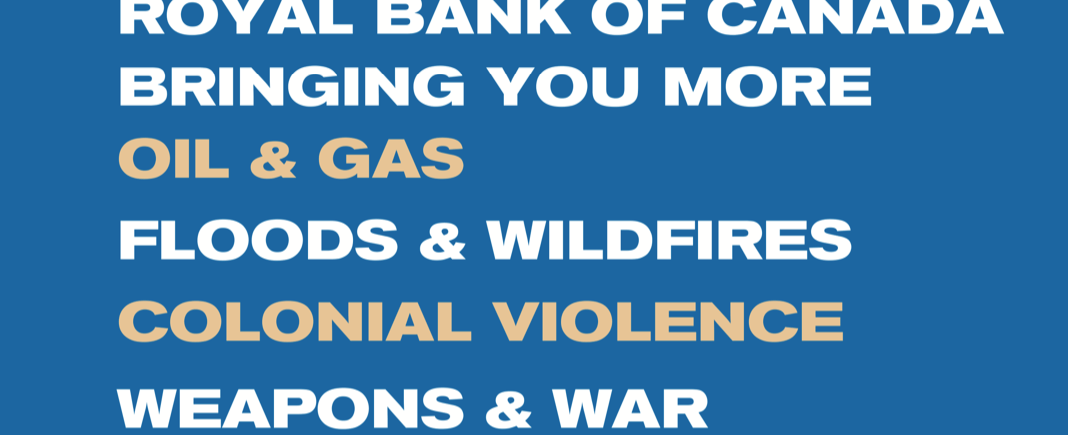
The Royal Bank of Canada (RBC) is one of the biggest climate-wrecking banks. It is investing heavily in weapons used in the genocide of the Palestinian people, and supports oil & gas projects which violate the rights of Indigenous peoples.

“I am Chief Na’Moks of the Wet’suwet’en. I am standing here in front of the Old Vic. The Old Vic is sponsored by the Royal Bank of Canada. The Royal Bank of Canada is also a sponsor of the violence that comes to our lands, and our people. Our people have been arrested, they have been removed, our cabins have been burned to the ground, they have come to our doors with axes and power saws, with attack dogs, with snipers.”
RBC’s sponsorship relationship with the Old Vic helps it promote itself as a socially responsible company and to advance its business objectives.
RBC’s contribution to the climate crisis
Every year, RBC is one of the world’s biggest funders of fossil fuels, ploughing hundreds of billions of dollars into the fossil fuel industry.
It invested US$ 33.7 billion in fossil fuels in 2022, and 28.2 billion in 2023.
It has invested more than US$ 250 billion in fossil fuel funding since the Paris agreement, in which countries committed to limit global temperature rises below 1.5 degrees. This includes investments and loans in major oil & gas giants, coal extraction, fracking and Alberta Tar Sands.
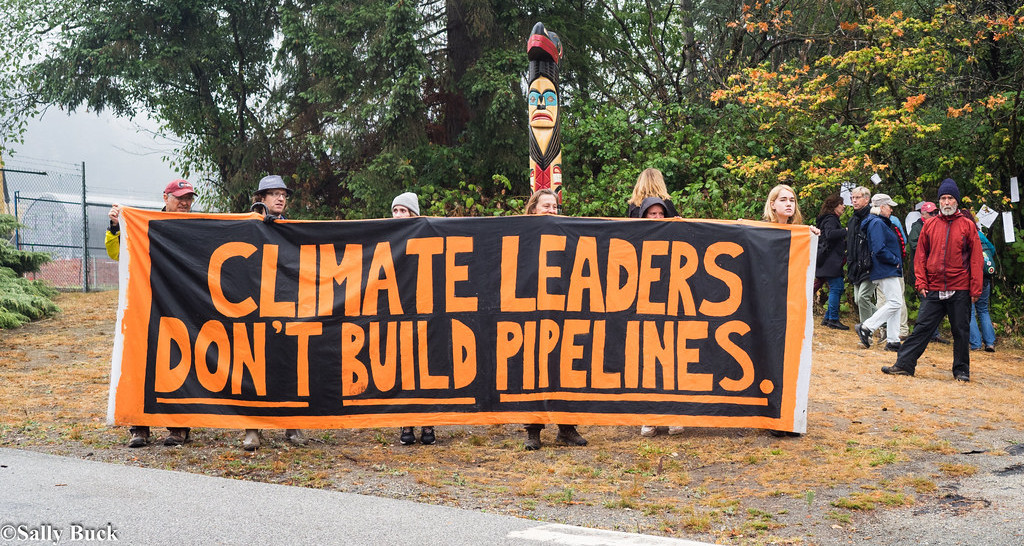
Image: Sally Buck, CC-BY-SA 2.0
RBC has loaned $1.944 billion to the Trans Mountain Pipeline Expansion Project, despite warnings from the UN and the International Energy Agency that there can be no further expansion of fossil fuel projects if we are to avert the most catastrophic effects of climate change.
It is ranked as one of the worst banks for coal phase-out policies, continuing to fund coal expansion and ranked 97th of 100 global banks by BloombergNEF for funding energy transition.
RBC’s latest climate report makes no mention of phasing out fossil fuels, and admits the majority of its oil and gas clients “do not have 1.5ºC aligned emissions reduction targets.” It makes no commitments to drop these clients or to support them to transition.
In spite of the clear signal from COP28 that we need to phase out fossil fuels in order to avoid the most devastating consequences of climate breakdown, RBC remains fully invested in its role of powering the fossil fuel industry.
The scale of the human impact of the projects RBC finances cannot be underestimated. On the current trajectory of greenhouse gas emissions, global communities are facing increasingly severe droughts, more intense storms and sea level rise, putting pressure on human health, food systems, livelihoods and ecosystems, in ways that will be irreversible if emissions are not rapidly brought down. According to independent assessments, RBC’s business practices are not remotely aligned with internationally agreed pathway to avert the worst impacts of climate change, which are already impacting countless communities across the globe, particularly in the Global South.
Human rights violations and climate colonialism
RBC has a record of violating human rights, particularly Indigenous rights within the place now known as Canada. Despite a promise that all RBC’s clients have “policies and processes consistent with the standard of free, prior and informed consent” with Indigenous communities, RBC continues to finance projects that violate Indigenous consent.
The Coastal Gaslink is a 420-mile pipeline that threatens Wet’suwet’en land and disregards Indigenous sovereignty. Five Wet’suwet’en clans have not provided free, prior, and informed consent to Coastal GasLink. The pipeline will also transport fracked gas, risking contaminated community drinking water and endangering human health, in addition to its climate impacts.
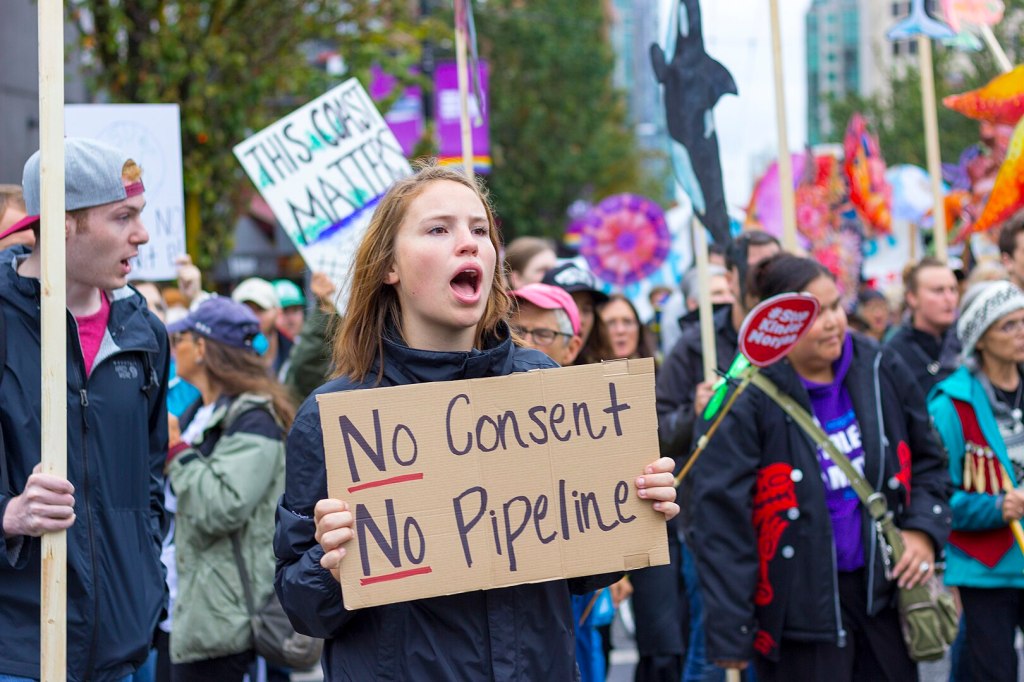
TMX Pipeline rally, September 2017, Vancouver. Image: William Chen, CC BY-SA 4.0
The Trans Mountain Expansion Project (TMX) also aims to construct a new tar sands pipeline, tripling the amount of diluted bitumen flowing from Alberta. It has been strongly opposed by affected Indigenous communities.
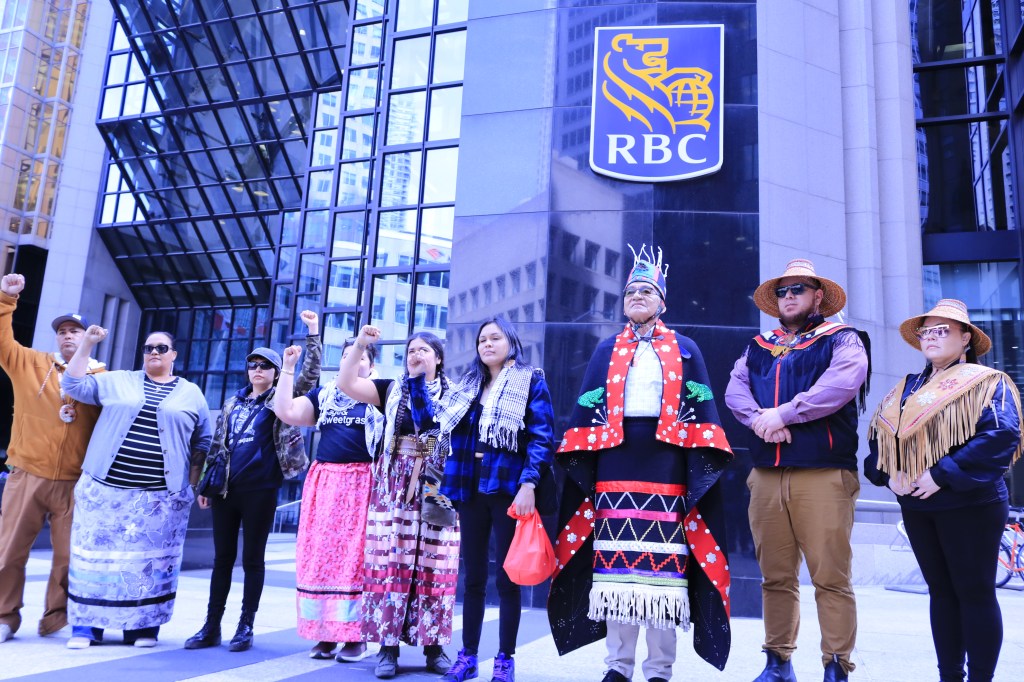
Indigenous Climate Action’s Water Walk ahead of RBC’s 2024 AGM, in solidarity for communities impacted by the Royal Bank of Canada’s funded projects. Image: Katie Wilson
At RBC’s 2023 AGM, an Indigenous, Black, and People of Colour delegation of shareholders were segregated to a back room, where they were only allowed to watch on a television screen. They were not allowed to raise questions in person about RBC’s operations or vote in person on resolutions. White attendees were allowed in the main conference room. In 2024, Indigenous delegates were repeatedly cut off, spoken over, and denied answers.
RBC is also financing petrochemical industries in the Gulf South, including Formosa Plastics, whose $9.4 billion ‘Sunshine Project’, an enormous plastics manufacturing plant, in St James, is being fiercely resisted by the local community.
“My community is dying because of people like RBC. They are out to make money; they don’t care if they pollute us; they don’t care if we don’t drink clean water, if we don’t breathe clean air.”
Sharon Lavigne, from Rise St. James, a faith-based grassroots organisation that works to defeat the proliferation of petrochemical industries in St. James, Louisiana
St. James is a predominantly-Black community in the so-called ‘Cancer Alley’ – surrounded by polluting industries and with rates of cancer many times higher than the national average. UN human rights experts have called for an end to further industrialisation in the area, naming it as environmental racism.
Internationally, RBC invests in countless extractive industries which cause human rights violations, and in war and genocide. Including significant shares in Total Energies, which, aside from being one of the world’s biggest oil and gas companies, is the lead partner in developing the East Africa Crude Oil pipeline, which is set to displace 118,00 people in Uganda forcibly and imperils the drinking water of a further 40,000, in addition to producing the same annual emissions of Uganda and Tanzania combined.
Complicity in the genocide in Palestine
RBC is on the Canadian Boycott Divestment and Sanctions list.
RBC holds billions of dollars of shares in weapons manufacturers supplying Israel, including General Dynamics and Lockheed Martin, whose weapons have been used to support its military occupation, apartheid and genocide in Palestine, and used in attacks on civilians.
General Dynamics supplies MK84 and MK82 bombs, 2,300 of which were sent to Israel by the U.S to be dropped on Palestinians in Gaza in March 2024 and have been used in previous assaults in Gaza, and also produced Namer armoured vehicles used in Israeli assaults on Gaza and its military occupation of the West Bank.
Lockheed Martin produces the F16 fighter jets repeatedly used by Israel in attacks on Palestinians over more than two decades and the F-35 fighter jets used in Israel’s current assault on Gaza.
Fuelled by this investment, these weapons have contributed to the killing of over 38,000 Palestinians since October 2023 according to the Palestinian Ministry of Health. The Lancet (July 2024) estimates the overall loss of life could exceed 186,000 people.
RBC also invests in Palantir Technologies, which provides Artificial Intelligence predictive systems to Israeli security forces, supporting Israel’s military occupation, settler colonialism and genocide in occupied Palestine.
 Culture Unstained