British Museum drops tobacco sponsor after government intervention, putting pressure on controversial BP deal
British Museum ends sponsorship deal with Japan Tobacco International (JTI) after Department of Health intervention
15-year corporate partnership breached international obligations on tobacco control
Museum under mounting pressure to reconsider 10-year deal with oil producer BP over health and climate impacts of company’s large-scale pollution
Royal Academy of Arts and London Philharmonic Orchestra still sponsored by JTI
The British Museum’s controversial partnership with the tobacco manufacturer Japan Tobacco International (JTI) has been quietly brought to an end following an apparent intervention from the Department of Health and Social Care (DHSC). The conclusion of the 15-year partnership came to light last week after the company’s name was removed from the museum’s website, the same day that a new report was published by the Tobacco Control Research Group which highlighted how the sponsorship deal had formed part of JTI’s wider influence and lobbying strategy.
The shift adds to the mounting pressure on the museum’s controversial 10-year sponsorship deal with the oil and gas producer BP – announced in December 2023 – with campaigners drawing parallels between how both JTI and BP use cultural sponsorship in order to deflect attention from the devastating health impacts of their toxic tobacco products and polluting fossil fuels. Last month, The British Museum also faced protest over its BP sponsorship during its inaugural ‘Pink Ball’ and in response to the museum hosting a private event for the Israeli Embassy earlier this year.
Professor Nicholas Hopkinson, a Professor at the National Heart and Lung Institute, Imperial College and Chair of the public health charity Action on Smoking and Health (ASH UK), has said:
“Allowing JTI to sponsor the British Museum was not just wrong in principle. It was also a clear breach of the government’s obligations under the WHO Framework Convention on Tobacco Control. The British Museum, as an arm’s length non-departmental public body sponsored by the Department for Culture, Media & Sport, is covered by this obligation to exclude the tobacco industry.
We welcome the decision that the British Museum has not renewed its sponsorship arrangement with Japan Tobacco International (JTI). This outcome is a positive step in ensuring that our national cultural institutions are not accepting money from such an inappropriate source, and we urge the government to ensure that similar breaches in its treaty obligations do not occur in the future.”
For many years, tobacco sponsorship has been considered beyond the pale in the culture sector, with scrutiny shifting to corporate sponsors linked to fossil fuels, weapons manufacture and the genocide in Palestine. Last month, 91% of Museums Association members voted to adopt a new Code of Ethics that now expects museums to:
‘Transition away from sponsorship from organisations involved with environmental harm (including fossil fuels), human rights abuses, and other sponsorship that does not align with the values of the museum.’
Dr Simon Opher MP has said:
“As a GP and Chair of the Health APPG, I find it deeply troubling that a national cultural institution has been sponsored by a tobacco company for 15 years in clear breach of WHO guidelines. Tobacco is one of the leading causes of preventable death, and there is no circumstance in which public bodies should be legitimising an industry that profits from harm.
This case also highlights a wider issue: harmful industries such as tobacco and fossil fuels continue to use sponsorship to buy influence and credibility despite the enormous health impacts of their products. We urgently need stronger legislation and proper enforcement to ensure that our cultural institutions and public bodies are not used as vehicles for corporate whitewashing at the expense of public health.”
The UK Tobacco Industry Interference Index 2025 – published last Tuesday on the day that The British Museum also removed references to JTI from its website – highlighted that:
‘As of March 2025, the British Museum – non-departmental public body sponsored by the Department for Culture, Media & Sport (DCMS) – lists JTI as a corporate supporter on its Website. During the timeframe of this Index, the BM had repeated contact with JTI[…] The authors of this report have heard via personal correspondence that the British Museum’s Trustees have decided not to renew their partnership with JTI when the current arrangement ends in September 2025.’
Far from being a proactive ethical decision by the Museum, FOI disclosures suggest that the Board took that decision only after intervention from the Department of Health and Social Care, following concerns raised by Public Health experts that the partnership with JTI was likely in breach of Article 5.3 of the World Health Organisation’s (WHO) ‘Framework Convention on Tobacco Control’ (FCTC), which was ratified by the UK government in 2004.
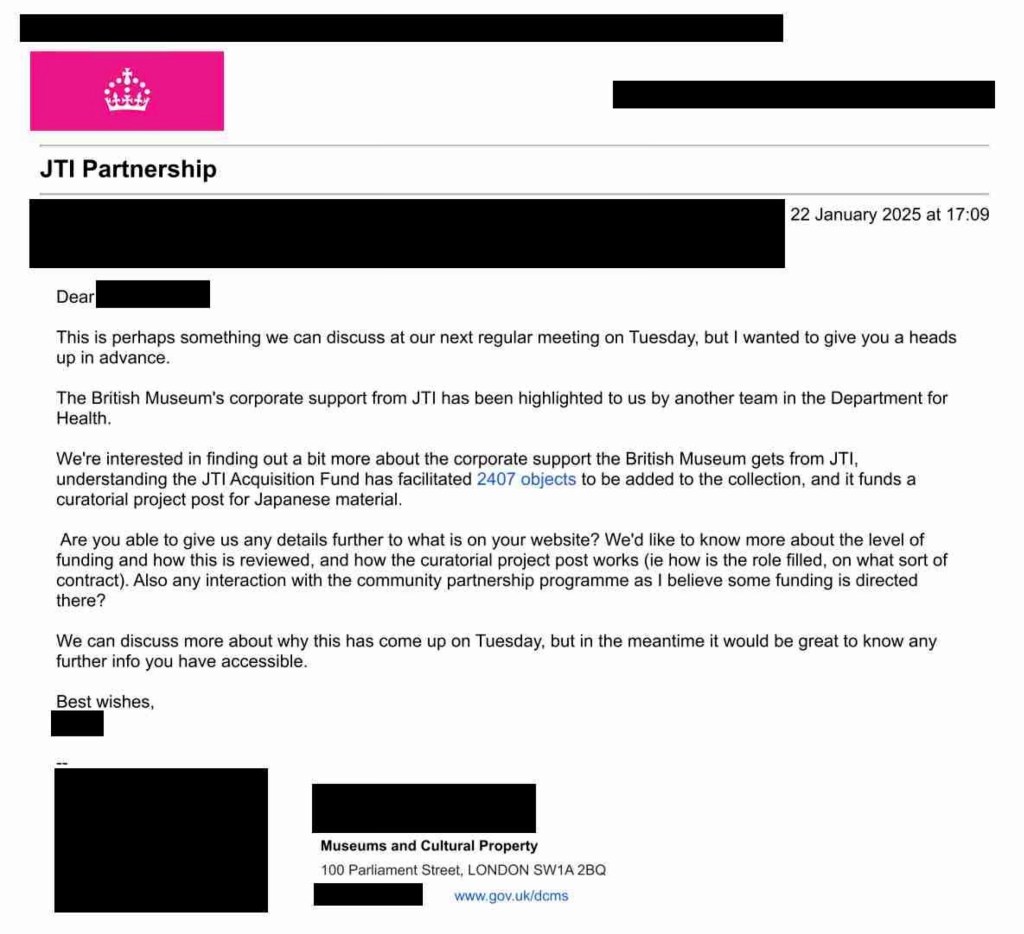
Following an FOI request by the organisation Culture Unstained, an email sent to the Museum on 22nd January 2025 by a civil servant in the Department for Culture, Media & Sport (DCMS) was disclosed. It says:
“The British Museum’s corporate support from JTI has recently been highlighted to us by another team in the Department for Health […] We can discuss more about why this has come up on Tuesday…”
It then asks for more information about the support; its value, how it is reviewed and the projects funded by JTI.
Professor Dame Theresa Marteau, Research Professor Emerita in Behavioural Science at the University of Cambridge, wrote to DHSC in January to raise concerns about JTI’s sponsorship of The British Museum. She has said:
“The UK is set to become the first country worldwide to protect the next generation from the lethal but legal tobacco industry by prohibiting the sale of tobacco to all those born after 2009. It struck me as anomalous and possibly in contravention of its obligations as a signatory of the UN Framework Convention on Tobacco Control that the UK government was also funding an organisation taking money from this industry.
I therefore wrote to DHSC asking whether the British Museum’s acceptance of tobacco industry money contravened the UK government’s FCTC obligations given the Museum is sponsored by a government department, the Department for Digital, Culture, Media and Sport. I was told that DCMS had no influence over commercial deals of museums but that the matter would be raised with the Museum. I don’t know what happened next, but it is most welcome news that the British Museum is no longer taking money from JTI.”
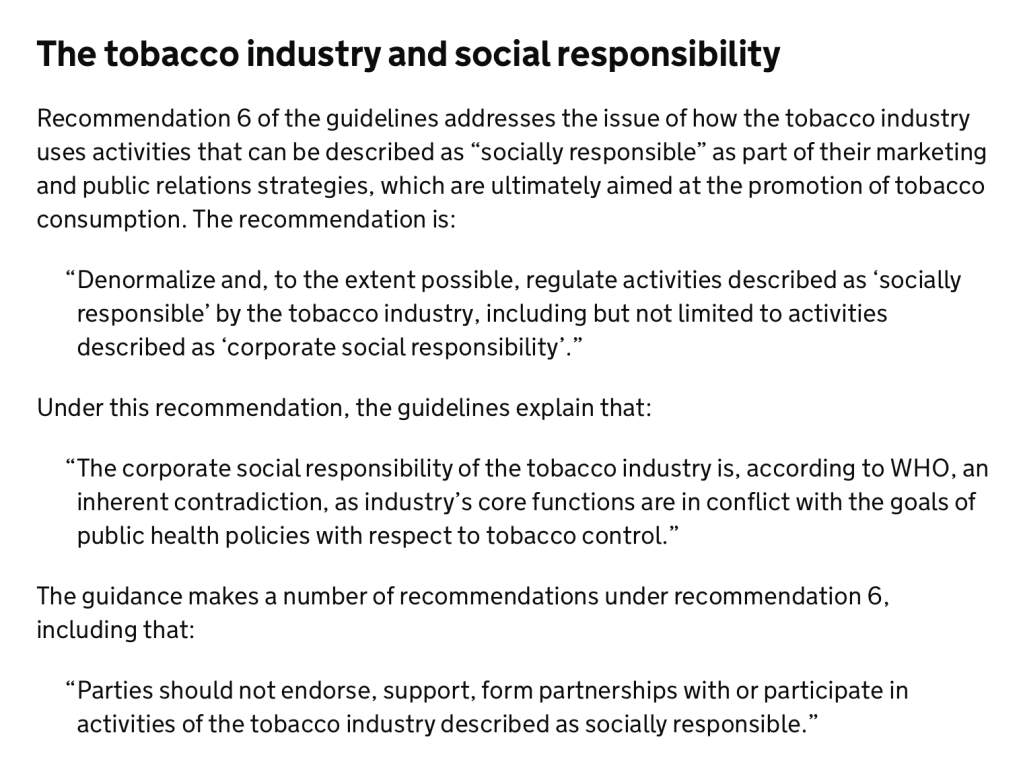
The Framework Convention on Tobacco Control expects signatories to:
‘Establish measures to limit interactions with the tobacco industry and ensure the transparency of those interactions that occur.’
And, crucially:
’Denormalize and, to the extent possible, regulate activities described as “socially responsible” by the tobacco industry, including but not limited to activities described as “corporate social responsibility”.’
“Applies across the UK government, including: government departments, arm’s length bodies [such as the British Museum], agencies, local authorities, any person or organisation acting on behalf of the above bodies.”
Guidance on Department of Health & Social Care website on application of Framework Convention on Tobacco Control
The Museum’s partnership with JTI has been a subject of intense controversy, widely criticised by public health experts In 2016, more than a thousand healthcare experts signed an open letter calling on cultural institutions to cut their ties with tobacco companies, saying:
“Tobacco advertising has now been banned along with sponsorship of sport. However, tobacco companies continue to use sponsorship of some high-profile arts organisations to promote the spurious idea that they are responsible corporate citizens.”
Far from being a philanthropic partnership, evidence suggests that JTI – like BP – has repeatedly leveraged its sponsorship deal with The British Museum as a means for furthering its harmful business. The Tobacco Industry Interference Index report notes how:
“Giles Watling [MP] (Clacton) disclosed a business lunch (£57.26) from JTI in January 2024, as well as a tour and dinner at the British Museum (£293.78), also from JTI in March 2024,that he was unable to attend.”
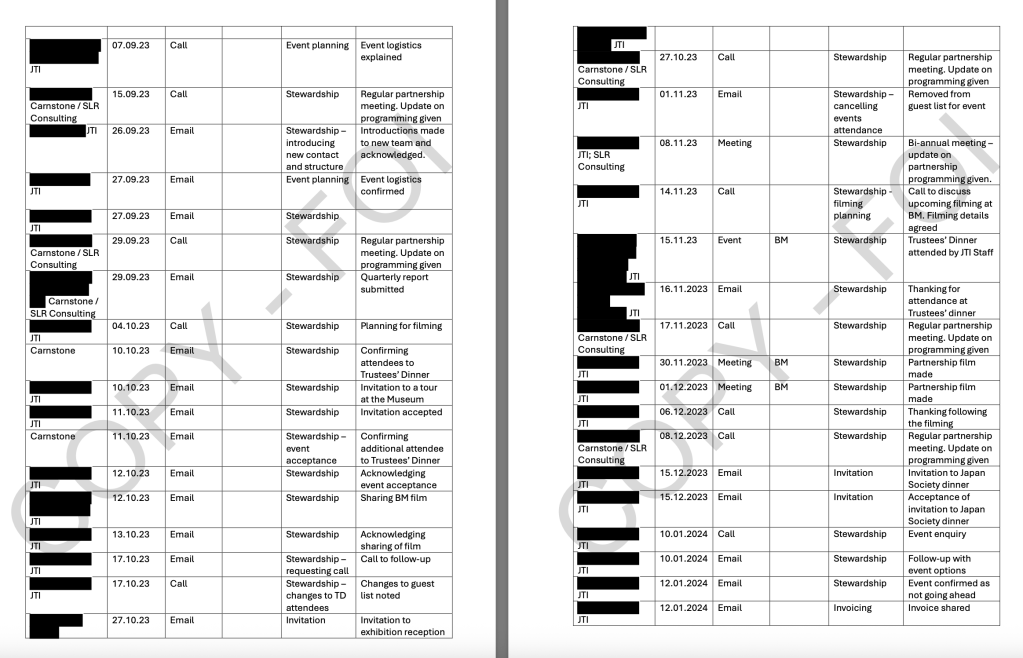
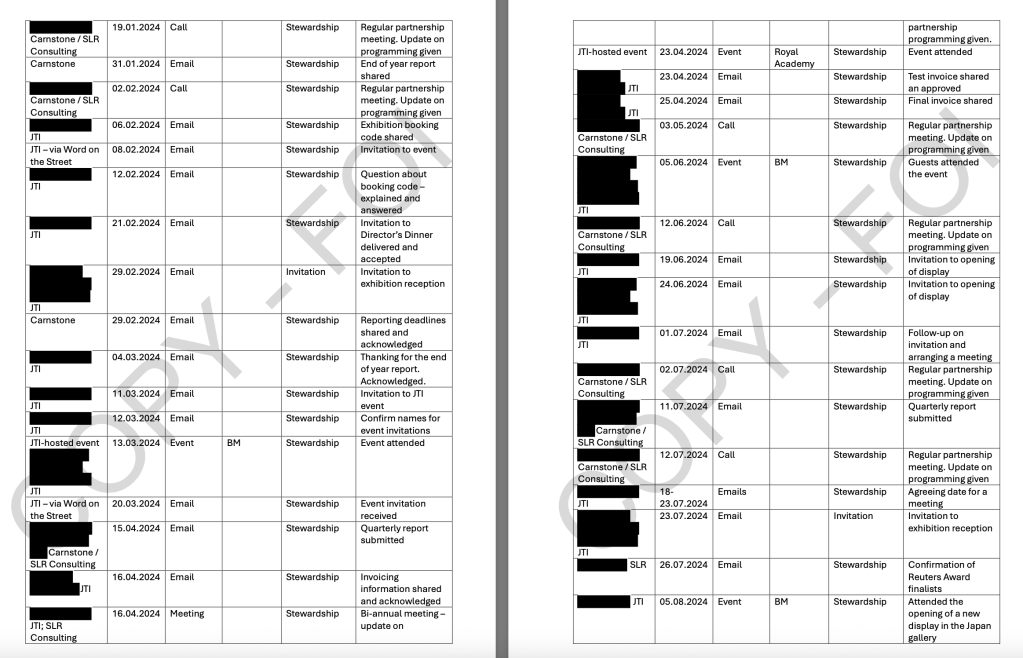
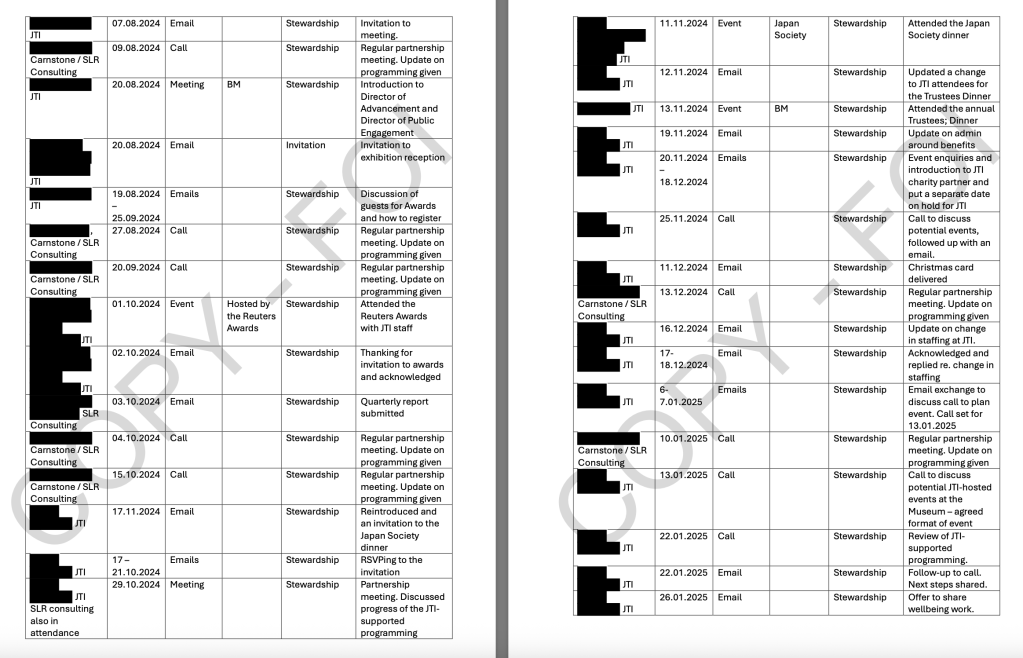
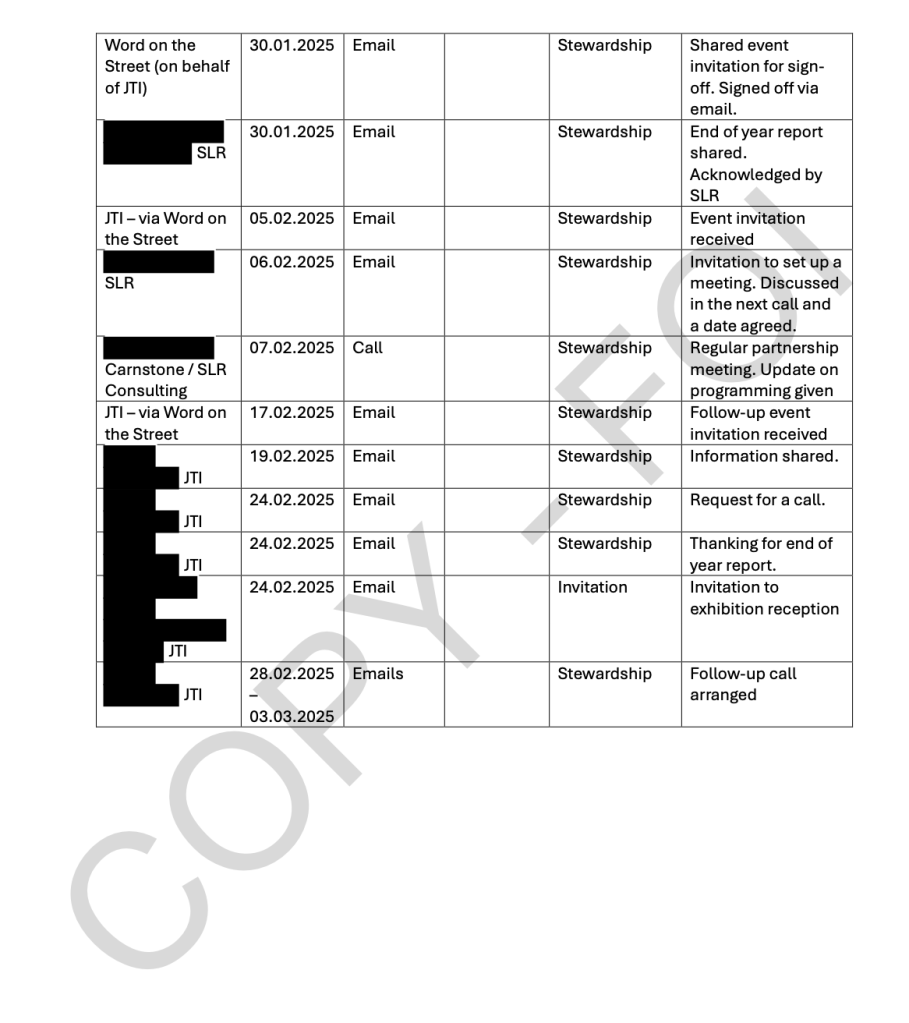
An FOI disclosure from April, obtained by the Tobacco Control Research Group – shown below – itemises the museum’s interactions with JTI and reveals the significant scale and depth of the relationship between museum and sponsor. As well as coordinating private events for its sponsor, Museum staff also attended other events at JTI’s invitation, including events at the the Royal Academy and the ‘Reuters Sustainability Awards’ with JTI staff, as well as the JTI-sponsored Japan Society dinner.
FOI disclosure by The British Museum itemising engagement with JTI and tobacco firms from 23 April 2023 to 10 March 2025
These events appear to be in breach of obligations under Article 5.3 of the WHO Framework Convention on Tobacco Control, with DHSC guidance explicitly stating that government organisations and their representativesshould:
“not accept invitations to attend or support a reception or high-profile event sponsored by the tobacco industry.”
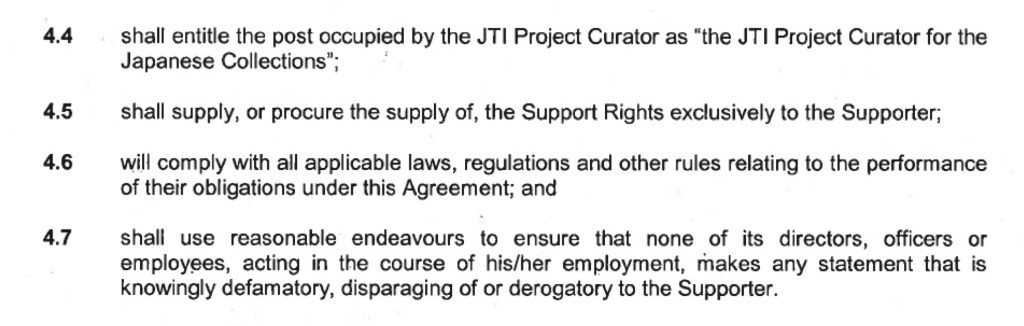
The Museum has continued to defend its partnership, which was agreed in 2010, five years after the FCTC came into force, saying as recently as November 2024 that: “The JTI is a longstanding corporate partner and we are grateful to them for their support.” The contract signed in 2013 between JTI and The British Museum also included a non-disparagement or “gagging clause”, which stated that the Museum:
“shall use reasonable endeavours to ensure that none of its directors, officers oremployees, acting in the course of his/her employment, makes any statement that isknowingly defamatory, disparaging of or derogatory to the Supporter.”
Excerpt from The British Museum’s partnership agreement with JTI signed in 2013
Since becoming Director of The British Museum, Nicholas Cullinan has sought to position himself as a champion of corporate sponsorship but has repeatedly sidestepped the clear ethical conflicts surrounding both JTI and BP. The failure of the Museum to end the JTI partnership prior to the Department for Health and Social Care’s intervention raises questions about the Museum’s leadership, internal ethics processes and the robustness of DCMS’s oversight.
Sarah Waldron, Co-director of Culture Unstained, an organisation that advocates for ethical arts funding and against fossil fuel sponsorship of culture, has said:
“When it comes to corporate sponsorship, The British Museum is morally bankrupt. The health impacts of tobacco products and fossil fuel pollution are undeniable – and yet the only reason the museum seems to have ditched JTI is because they were forced to – even though the partnership clearly fell foul of tobacco regulation that has been in place for years.
How long will we have to wait for the museum to act on the evidence and drop BP? Or will it recklessly continue to endorse BP even as floods, storms and wildfires intensity and devastate the very cultures and communities it claims to represent with its exhibitions and collection?
Just as with tobacco, fossil fuel companies like BP use sponsorship deals in order to deflect attention from the destructive impacts of their polluting products; just as with tobacco, now is the time for a ban on fossil fuel sponsorship and advertising.”
Image from JTI website promoting its cultural sponsorship deals
The British Museum was one of a handful of British cultural institutions sponsored by the tobacco industry, with the London Philharmonic Orchestra and Royal Academy of Arts both continuing to take money from JTI. Professor Nick Hopkinson, Chair of the public health charity Action on Smoking and Health, has called for the Department of Culture Media and Sport to introduce a no-tobacco clause to Arts Council funding:
“Given the Government’s commendable action on smoking, it makes little sense for the tobacco industry to be allowed to piggyback on taxpayer funding by sponsoring, often with relatively small amounts, arts organisations that are supported by public funds. Sponsorship of the London Philharmonic Orchestra by JTI is an example of this. As such, we would also suggest that policy be updated, so that in future, Arts Council England Funding will only be made available to organisations that exclude the tobacco industry.”
“JTI’s partnership with the British Museum has been raised as a concern by civil society repeatedly over the past few years, including in the two most-recent editions (2023 and 2025) of the UK Tobacco Industry Interference Index. The British Museum’s decision to end its long-standing partnership with JTI is thus a very welcome development – such agreements enable a deadly industry to use UK cultural institutions as a way to try and improve its public image, while continuing to sell products that kill. Other UK cultural institutions that have similar partnerships with tobacco companies, such as the London Philharmonic Orchestra, should follow in the British Museum’s footsteps and ensure that their reputations are no longer exploited by harmful industries”.
A reduction in smoking and improvements in health as a result of curbs on positive publicity for tobacco were cited in a parliamentary debate last July as evidence in support of a tobacco-style ban on fossil fuel sponsorship and advertising. In 2024, UN Secretary General António Guterres highlighted the parallels between tobacco and fossil fuels and said “I urge every country to ban advertising from fossil fuel companies.”
“Ending The British Museum’s partnership with a tobacco giant is long overdue, but it highlights a bigger contradiction. If tobacco sponsorship is unacceptable because of its deadly harms, then fossil fuel sponsorship must be too. The evidence is unmistakable: coal, oil and gas are poisoning our environment and harming us, driving the climate chaos, and causing millions of preventable deaths. Cultural institutions cannot claim to serve the public while lending credibility to industries that endanger our health. It’s time to treat fossil fuel advertising and sponsorship with the same urgency as tobacco.”
‘BP Must Fall’ protest at The British Museum in 2020. Photo: Ron Fassbender.
“Governments will only make real progress in addressing commercial harms—whether related to tobacco, fossil fuels, or other industries—when they strengthen the integrity of their governance processes. Any industry whose profits stand to be affected by public policy should not participate in negotiating those policies, as their involvement presents an obvious conflict of interest.
Decades of evidence in tobacco control have shown that shielding policymaking from the vested interests of the tobacco industry was essential to reducing the enormous harms caused by smoking. Those lessons are now directly relevant to climate policy: protecting decision-making from companies whose business depends on continued fossil fuel extraction and use is necessary to confront the environmental and health impacts driven by these activities.”


 Culture Unstained