
This week, the UK parliament debated a ban on fossil fuel advertising and sponsorship for the first time in what is, hopefully, the first step towards legislation that would limit the industry’s ability to promote its polluting products and spread disinformation. The call for a ban has been growing from those such as the UN Secretary General, its Special Rapporteur on Human Rights & Climate Change and last week, from over 100 ad agencies and organisations who signed a letter calling for legislation. Meanwhile, artists, performers and workers continue to support calls for an end to fossil fuel sponsorship of culture.
“I urge every country to ban advertising from fossil fuel companies.”
António Guterres, UN Secretary General, June 2024
What makes fossil fuel advertising and sponsorship so toxic is that it not only muddies the waters around climate action and the energy transition, it also deflects from the polluting impacts companies such as BP, Shell, Equinor and Adani have on communities across the world. The fossil fuel industry is, in many ways, a product of Britain’s imperial past with its roots in the colonial theft of resources. The fact that the pollution from these companies, as well as their climate impacts, affects communities across the Global South the most severely only further reinforces this inequality. For this reason, the UK has a responsibility to bring an end to the industry’s ability to promote itself and obscure its impacts.
Museum sponsor BP profits from war and poisons communities
BP, for example, is a company that sponsors The British Museum and the Science Museum, and splashes greenwashing adverts across Westminster tube station promoting its “green credentials”. But in Iraq the company has a toxic history. Ahead of the invasion of Iraq in 2003, minutes from a Foreign Office meeting with BP recorded that:
“Iraq is the big oil prospect. BP is desperate to get in there and anxious that political deals should not deny them the opportunity.”
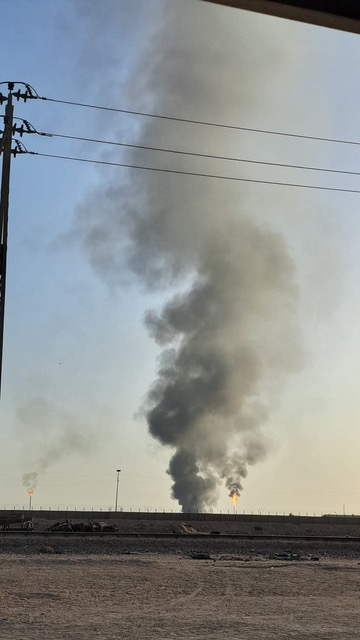
Today, BP’s gas flaring is having dire health impacts and was the subject of an award-winning BBC documentary, Under Poisoned Skies. Abu Ali, whose son featured in the documentary, is now pursuing legal action against BP.
“My message is this: Save us from the polluted air and the emissions from oil and gas flaring. I lost my son, Ali (may God have mercy on him), to cancer. He was 18 years old when he first became ill. Now, the number of cases is increasing. There are approximately 40 to 45 people either deceased or currently being treated for cancer-related illnesses in Rumaila, caused by the oil pollution.
For your information, I spent all the family’s money, household furniture, and gold jewelry to cover the cost of Ali’s treatment—may God have mercy on him. Do I have any rights to reclaim what I lost? What responsibility do the authorities have? Where did they go? Where are they hiding? At the very least, I ask for compensation—both material and moral.
To the leaders of BP I say this: You are responsible for what is happening in my area and for the fact that I lost the dearest person in my life—my son, who can never be replaced at any cost. But you must offer compensation, because it is my right.”
Greenwashing coal and supporting human rights abuses
Meanwhile, a subsidiary of the Adani Group sponsors the Science Museum’s new climate and energy gallery – Adani is the world’s biggest private producer of coal. Uncle Adrian Burragubba, one of the Wangan and Jagalingou Traditional Owners of the land where Adani is building its vast Carmichael coal mine in Queensland, Australia, has said:
“The Science Museum should be respecting the fundamental human rights of Indigenous peoples. Instead, director Ian Blatchford has dismissed us and chosen to support Adani, a company that is destroying our land and violating our rights. Every step of the way, Adani has used lies and deception to persecute my people, interfere in our decision making processes, and undermine our rights to self-determination…
Adani’s coal mine has no Free, Prior and Informed consent from Wangan and Jagalingou people. We know the damage this mine will cause to our ancestral homelands and we continue to oppose it. Adani’s corporate behaviour is in clear violation of human rights, not only of Indigenous people in Australia, but Indigenous people all around the world. Adani works to shut Indigenous people up, to criminalise us, and bankrupt us. Adani is not a good corporate citizen. I certainly wouldn’t take money from them.”
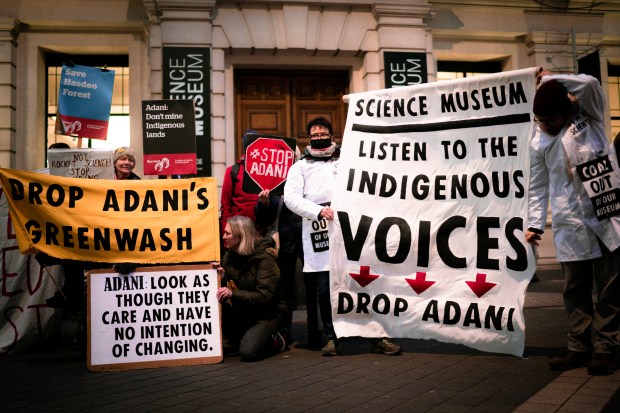
Sunita Devi, is an Adivasi woman, leading a mass resistance in Hazaribagh district in Jharkhand, India where Science Museum sponsor Adani is taking over prime agricultural land and dense forest for a proposed Coal mining project. She has said:
“We don’t want Adani here. Despite hardships (they have jailed my husband) we are managing, growing and selling paddy, sugar and other things. It pays for our children’s education. What has Adani got to tell us about development? Nothing! They are digging up and destroying our mother earth while the company’s goons are offering us bribes, but we won’t take their money and become slaves to the company. At night they come outside our houses and threaten and abuse us. We are united, thousands of us! We will continue to resist.”

In 2022, Adivasi resistance to Adani coal-mining projects in the Hasdeo Forest, Chattisgarh prevented the clearing of trees.
The organisation India Labour Solidarity also highlights how:
“In India, the impacts of global warming are no longer a distant threat, they are a brutal present reality. Extreme heatwaves have become annual occurrences, with 2024 seeing one of the worst summers in recent history. According to government data, at least 167 people died in just one week of extreme heat this June, with thousands more hospitalised. However, this figure is widely understood to be a vast undercount. Studies suggest that only around 10% of heat-related deaths are officially recorded…
Research by the Runnymede Trust and Friends of the Earth has shown that Black and Brown communities [in the UK] are more likely to live in areas with high exposure to air pollution, toxic waste, and climate risks. The Indian diaspora, concentrated in urban centres and working-class neighbourhoods, is disproportionately at risk from climate-linked events, including flooding and heatwaves…
Companies who profit from environmental destruction should not be allowed to buy legitimacy through sports, arts, and public events ,especially when their actions are fuelling climate collapse and silencing resistance.”
Fossil fuels are the biggest global threat to human health
Health professionals have likened fossil fuel advertising and sponsorship to tobacco marketing, which was ended by Tony Blair’s Labour Government in 2002.
Fossil fuels are the leading cause of climate change, which health bodies warn is the biggest global threat to human health, with a disproportionate impact on those who have done the least to cause it and who are most marginalised by global economic systems. Air pollution, primarily driven by the burning of fossil fuels, kills 30,000 people every year in the UK, at a cost of £27m to the NHS.
Restrictions on tobacco marketing have reduced the uptake of smoking by 37%. International climate and health leaders have now added their voices to the call for the UK government to now ban fossil fuel advertising and sponsorship.
Dr Jemilah Mahmood, Executive Director of Sunway Centre for Planetary Health, in Malaysia has said:
“Banning fossil fuel advertising isn’t censorship — it’s a vital public health intervention. Just as tobacco ad bans saved lives, ending fossil fuel promotion protects our communities and clears the path for clean energy. The UK must lead by example, setting bold regulations that put people’s health and our planet above industry profit.”
In Australia, Dr Kate Wylie is Executive Director of Doctors for Environment Australia:
“The UK Parliament has a critical opportunity to show leadership by banning fossil fuel advertising, just as the world once did with tobacco. This is not about politics — it’s about protecting public health. The climate crisis knows no borders. In Australia, we’ve seen firsthand how coal, oil and gas drive disease, displace communities, and deepen the climate crisis — causing more harm than smoking. We are all affected, and bold action is needed everywhere, from London to Sydney.”
Dr Laalitha Surapaneni, MD, MPH from Internist, In the USA, said:
“As a physician, I see the health harms of fossil fuel pollution every day — people struggling with asthma, elders suffering heat-related strokes, and entire communities living in the shadow of polluting infrastructure. These are not distant threats; they are unfolding in my hospital and my community. Advertising plays a powerful role in making harmful products seem desirable — we’ve seen it before with tobacco. The UK Parliament has a chance to show global leadership by banning fossil fuel ads and stopping the normalization of pollution. This is a matter of public health, and the urgency couldn’t be clearer.”
Dr. Elaine Mulcahy, Director of the UK Health Alliance on Climate Change, said:
“Advertising fossil fuels is incompatible with public health. Just as we once banned tobacco ads to protect people from a deadly product, we must now do the same with fossil fuels, which are driving a global health crisis through air pollution, climate change, and environmental degradation. The UK Parliament debate is an important step toward ending the normalization of an industry that harms health across every stage of life. As a supporter of the Break the Fossil Influence campaign, UKHACC is encouraging health organisations to cut ties with PR and advertising agencies that work to greenwash fossil fuel companies. This is about protecting lives and restoring integrity to public messaging.”
They are among 30 health organisations, representing 12 million health professionals worldwide which have publicly ended their ties to fossil fuel advertising.
Enabling and profiting from genocide
Major fossil fuel companies are also enabling and profiting from the genocide and colonisation of Palestine. BP, which uses its sponsorship of the British Museum to burnish its image and access decision-makers, is a major oil supplier to Israel, with some of this oil refined into jet fuel for use by the IDF. It also operates the BTC pipeline which transports oil from Azerbaijan to Israel.
Energy Embargo for Palestine said:
“Sponsorships and advertising are used by fossil fuel companies to manufacture consent in the imperial core for their operations. We know that these fossil fuel giants are attempting to conceal the violence of their extraction behind sanitised images of themselves as champions of arts and education, green energy, and progress. At a time when these companies are rolling back on even the most meagre pretences of green transition, these sponsorships function to spatially and temporally dislocate consumers here in Britain from the ecological destruction and labour exploitation inherent within the capitalist supply chains of fossil fuels around the world, including in Palestine, where BP is currently fuelling a genocide with crude oil, and profiting from it via gas exploration.”

The Indian conglomerate Adani, which puts its name to the Science Museum’s climate change gallery while remaining the world’s biggest private producer of coal, is also a weapons producer. It has a joint venture with Israeli arms company Elbit Systems, manufacturing and supplying the Hermes drones that are advertised as having been “battle-tested” in Gaza.
Parents for Palestine, who are calling for an educational boycott of the Science Museum until it drops Adani said:
“The fossil fuel industry fuels and profits from mass atrocities across the globe. Investor-owned and private oil companies supply 66% of oil to Israel – more than a third (35%) of that from major oil companies like Chevron, Shell and BP – despite genocide warnings from the International Court of Justice. Companies like arms and coal producer Adani and oil giant BP are exploiting our cultural institutions to ‘greenwash’ and legitimise their dirty profits.”
Time for change
Advertising and sponsorship is part of a decades-long strategy by fossil fuel companies to obscure and deny their role in driving climate change and block climate action.
As Jacob Collier MP said as he opened the debate:
“Fossil fuel advertising is not just a matter of a few billboards here and there, it is increasingly a co-ordinated strategy to build trust, shape culture and delay structural change…. Fossil fuel companies, as uncovered in the internal BP advertising memos, seek to reinforce their social licence and influence consumer behavior by associating themselves with progress, positivity and public good.”
As these voices and perspectives make clear, advertising and sponsorship is also a coordinated strategy to deflect from the polluting and destructive impacts the fossil fuel industry has on communities around the world. Bringing in a ban would stop the likes of BP, Shell and Adani from cynically trying to hide the reality of their business.
 Culture Unstained